Haplogroup G-M201 G
G-M201 is a branch of the FamilyTreeDNA Y tree with 10,284 kits that gave a country, counting all sub-branches. Stands out most: Adygea, Russia (44%); North Ossetia-Alania, Russia (48%); Abkhazia, Georgia (42%). The branch's common ancestor lived about 28k years ago: the FTDNA Discover estimate runs from 25k to 32k years ago. YFull has 2,394 samples in this branch and dates its common ancestor to 26k years ago.
Wikipedia says G-M201 is widely thought to have originated in Western Asia and is now most common among ethnic groups of the Caucasus. Digora, North Ossetia, has the highest known concentration of G in a single city. It has also been found in Neolithic Anatolia (Boncuklu, 8300–7600 BCE); Hallast et al. (2021) give an origin of more than 31,100 years ago.
Sources: Wikipedia ↗
This branch on other trees: FTDNA Discover ↗ · YFull ↗ · TheYtree ↗
Branch SNPs: 322 · 82 more at YFull
M201, BY21262, BY21263, BY21264, BY2378, CTS10026, CTS1010, CTS1013, CTS10280, CTS1029, CTS10393, CTS10706, CTS10721, CTS10723, CTS10824, CTS10945, CTS11185, CTS11228, CTS11331, CTS1137, CTS1139, CTS11400, CTS11529, CTS11584, CTS11670, CTS11702, CTS11907, CTS11911, CTS12040, CTS12240, CTS12309, CTS1259, CTS12600, CTS12654, CTS1270, CTS12704, CTS12731, CTS1283, CTS12949, CTS13035, CTS1437, CTS1574, CTS1577, CTS1612, CTS1613, CTS1624, CTS1705, CTS1726, CTS175, CTS1750, CTS1768, CTS189, CTS1997, CTS2016, CTS2120, CTS2125, CTS2126, CTS2136, CTS2174, CTS2215, CTS2251, CTS2271, CTS2357, CTS2506, CTS2517, CTS2624, CTS282, CTS34, CTS3693, CTS373, CTS3752, CTS4101, CTS4238, CTS440, CTS4479, CTS4523, CTS4613, CTS4749, CTS4761, CTS4887, CTS5317, CTS5414, CTS5498, CTS5504, CTS5640, CTS5658, CTS5699, CTS5757, CTS5837, CTS6073, CTS635, CTS6483, CTS670, CTS6807, CTS6894, CTS692, CTS6936, CTS6957, CTS7092, CTS7269, CTS7388, CTS7674, CTS7929, CTS8023, CTS827, CTS8531, CTS8717, CTS9011, CTS9190, CTS9593, CTS9641, CTS9707, CTS9710, CTS9894, CTS995, FGC77405, FGC77406, FGC77410, FGC77412, FGC77414, FGC77417, FGC77418, FGC78561, FGC79229, FGC79248, FT32, L109, L116, L1258, L1342, L1407, L154, L204, L269, L382, L402, L519, L520, L521, L522, L523, L524, L605, L769, L770, L836, L837, M3438, M3453, M3468, M3489, M3494, M3554, M3560, M3569, M3589, M3598, M3601, M3606, M3633, P257, PAGES00094, PF2788, PF2790, PF2791, PF2793, PF2796, PF2802, PF2804, PF2805, PF2806, PF2808, PF2809, PF2815, PF2816, PF2817, PF2819, PF2821, PF2827, PF2831, PF2832, PF2836, PF2837, PF2844, PF2857, PF2858, PF2859, PF2861, PF2862, PF2865, PF2866, PF2867, PF2868, PF2869, PF2871, PF2872, PF2873, PF2874, PF2875, PF2876, PF2877, PF2878, PF2879, PF2880, PF2881, PF2884, PF2888, PF2889, PF2890, PF2894, PF2896, PF2901, PF2902, PF2908, PF2910, PF2914, PF2915, PF2917, PF2918, PF2919, PF2920, PF2921, PF2932, PF2949, PF2954, PF2956, PF2958, PF3022, PF3045, PF3046, PF3048, PF3049, PF3050, PF3052, PF3053, PF3054, PF3057, PF3059, PF3061, PF3063, PF3065, PF3067, PF3068, PF3069, PF3070, PF3071, PF3074, PF3075, PF3076, PF3077, PF3080, PF3083, PF3085, PF3087, PF3088, PF3092, PF3094, PF3103, PF3117, PF3118, PF3121, PF3122, PF3123, PF3134, PF3265, S13661, S13716, S14351, S8863, U17, U2, U20, U21, U3, U33, U7, Y226, Y229, Y231, Y235, Y239, Y246, Y258, Y271, Y303, Y309, Y332, Y345, Y351, Y375, Y383, Y390, Z3030, Z3067, Z3069, Z3078, Z3080, Z3081, Z3097, Z3104, Z3107, Z3117, Z3135, Z3136, Z3144, Z3145, Z3239, Z3246, Z3247, Z3248, Z3250, Z3262, Z3314, Z3482, Z3485, Z3507, Z3539, Z6041, Z6133, Z6138, Z6324, Z6472
The same mutation arose again on other branches: CTS1139 — J-BY40138; CTS1624 — J-ZS2148; CTS189 — S-MY95; CTS2016 — H-Z4542; CTS2251 — J-FTC48809; CTS4479 — A-V148; CTS4523 — I-FT384415, I-CTS4523; CTS4887 — R-ZP121, I-BY152608; CTS6807 — R-FT128329; CTS7388 — N-CTS7388; L769 — J-ZS12541; M3453 — R-BY45040, R-FT404418; M3489 — I-BY87395; PAGES00094 — N-FT246723, J-BY41190; PF2805 — I-Z138; PF2857 — R-FTD22878; PF2871 — T-FTC39908; PF3052 — J-BY56454, J-PF3052; PF3067 — I-FTB66215
YFull nodes on this branch and their SNPs that FTDNA does not have:
- G · 1 sample
Y462103, Y462166, Y462125, Y468745, Y462160(H), Y462149(H), Y352987(H), Y471080(H), Y468780(H), Y468782(H), Y462151, Y462141(H), Y462148(H), Y462178(H), Y462130(H), Y462170(H), Y462133(H), Y462174(H), Y478043(H), Y462153(H), Y462176(H), Y462142(H), Y471084(H), Y462165(H), Y462109(H), Y462169(H), Y462104, Y471076(H), Y462147(H), Y462129(H), Y462136(H), Y462177(H), Y462168(H), Y462152(H), Y462127(H), Y471092(H), Y462123(H), Y352980(H), Y462139, Y468815, Y462106, Y462162(H), Y352958(H), Y462172(H), Y462114(H), Y352970(H), Y462137, Y462138(H), Y462135, Y352975(H), Y462173(H), Y352985(H), Y462155(H), Y462100, Y462161(H), Y462107(H), Y353027(H), Y497044(H), Y462110, Y462112(H), Y352961(H), Y462116, Y462118, Y462119(H), Y462167(H), Y462124(H), Y352990(H), Y352991(H), Y462128, Y462117, Y462115(H), Y462121, Y462163(H), Y462120, Y462122(H), Y468744, Y468746(H), Y352960(H), Y479741(H), Y490982(H), Y352977(H), Y462134(H)
Where it is found #
Countries and regions given by the branch's carriers. “Share of branch” is the part of the branch's kits that belongs to the country. “Share of country” is the part of that country's kits that falls into the branch; it is computed only for countries with at least 50 kits.
PalaeolithicMesolithicNeolithicChalcolithicBronze AgeIron AgeMiddle AgesModern eraMinus means BCE; epoch boundaries are conventional.
Where the ancestors of FamilyTreeDNA geographic project members on this branch lived, from the project maps as of 2026-10-20. Colour is the branch's share of the members at a place, or the number of its carriers; places with fewer than three are left blank. The centre and the 68% circle are corrected for some countries testing more than others. This is a picture of the sample: members chose whether to join and which place to give.
Ancient samples of the branch and its subclades with a date and a find site, from FamilyTreeDNA Discover, 893 in all. The slider picks the years; the older the era, the wider the window.
Ancient samples and today's carriers #
How far from the branch's present-day centre its ancient samples were found. The centre and the 68% circle are the same as on the project map above. Find sites are taken from the Mitotree in FTDNA Discover.
Ancient samples with a known site: 893. 797 lie inside the 68% circle; half of all are within 1,350 km of the centre. The centre of the ancient finds (Hungary) lies 980 km from today's.
Farthest from the centre
- Manda, Lamu, Kenya, 1,522 CE ? G-P15 — 5,230 km
- Roopkund Lake, Uttarakhand, India, 1,819 CE ? G-Z3292 — 4,620 km
- Simutasi, Xinjiang, China, 1,075 CE ? G-P303 — 4,140 km
Today's carriers are geographic project members: they chose whether to join and which place to give. Ancient samples are the ones studies have covered, and some regions are better excavated than others. The chart puts samples of different eras side by side.
Migration path #
How the branch's ancestral line moved, as modelled by FamilyTreeDNA Discover: ancestor locations are estimated from present-day carriers, the path between them is the least-cost route over terrain. Dates are node TMRCAs, good to centuries. The path ends at a fork of child branches: click one and the path continues into it.
The line moved fastest 65,300–48,600 years ago: 3,000 km, about 180 km per millennium. In all, the line covered 10,600 km along Discover's route. Joining the ancestors with straight lines gives 8,300 km; a straight line from the first point to the branch gives 4,800 km.
Show the mapHide the map The map unfolds by itself as you scroll down to it.
Loading the map…
Most common among these peoples #
From YFull samples that gave a mother tongue: the part of a people's samples that falls into this branch. The list has peoples with at least 30 samples, 3 or more of them in this branch.
- Svans: 81% of samples (25 of 31)
- Ossetians: 60% of samples (30 of 50)
- Abkhazians: 55% of samples (36 of 66)
- Adyghe: 47% of samples (110 of 232)
- Georgians: 46% of samples (38 of 83)
- Pontic Greeks: 38% of samples (19 of 50)
- Karachay-Balkars: 36% of samples (46 of 128)
- Saudi Arabian Sign Language: 28% of samples (9 of 32)
From FamilyTreeDNA projects
The kits are the ones the ypredictor predictor uses: the part of a people's kits that falls into this branch. A people is listed when the branch holds at least 5 of its kits and at least 10% of all of them.
- Kumyks: 15% of kits (44 of 290)
Sub-branches #
Sub-branches that have their own page (50 kits or more), as a tree: every direct one, nested ones from 1% of the branch's kits. The bar is the kits in the sub-branch with its own sub-branches; the age is when its common ancestor lived.
On the branch itself, without a resolved sub-branch: 1,647 kits.
Phylogenetic tree #
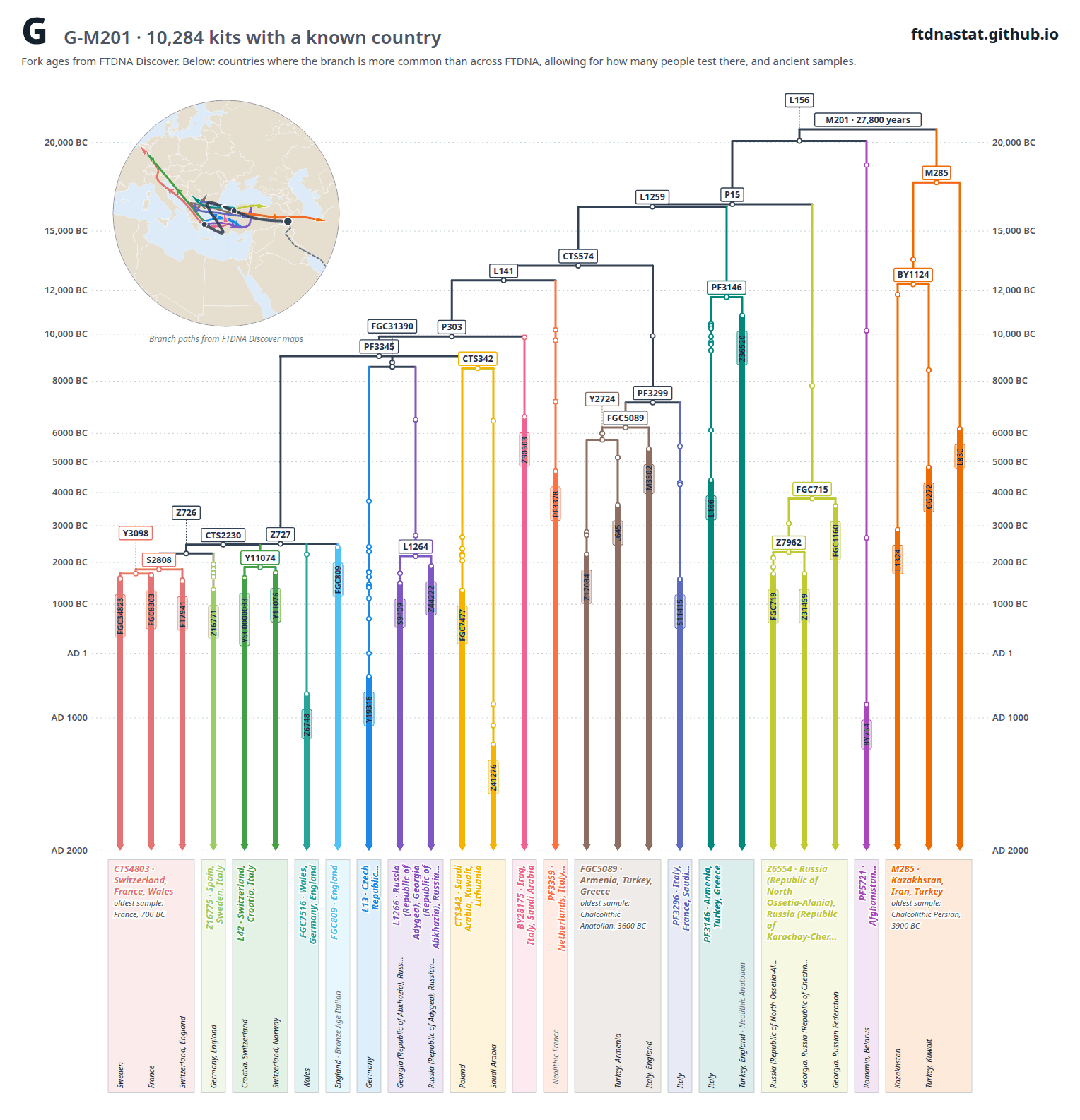
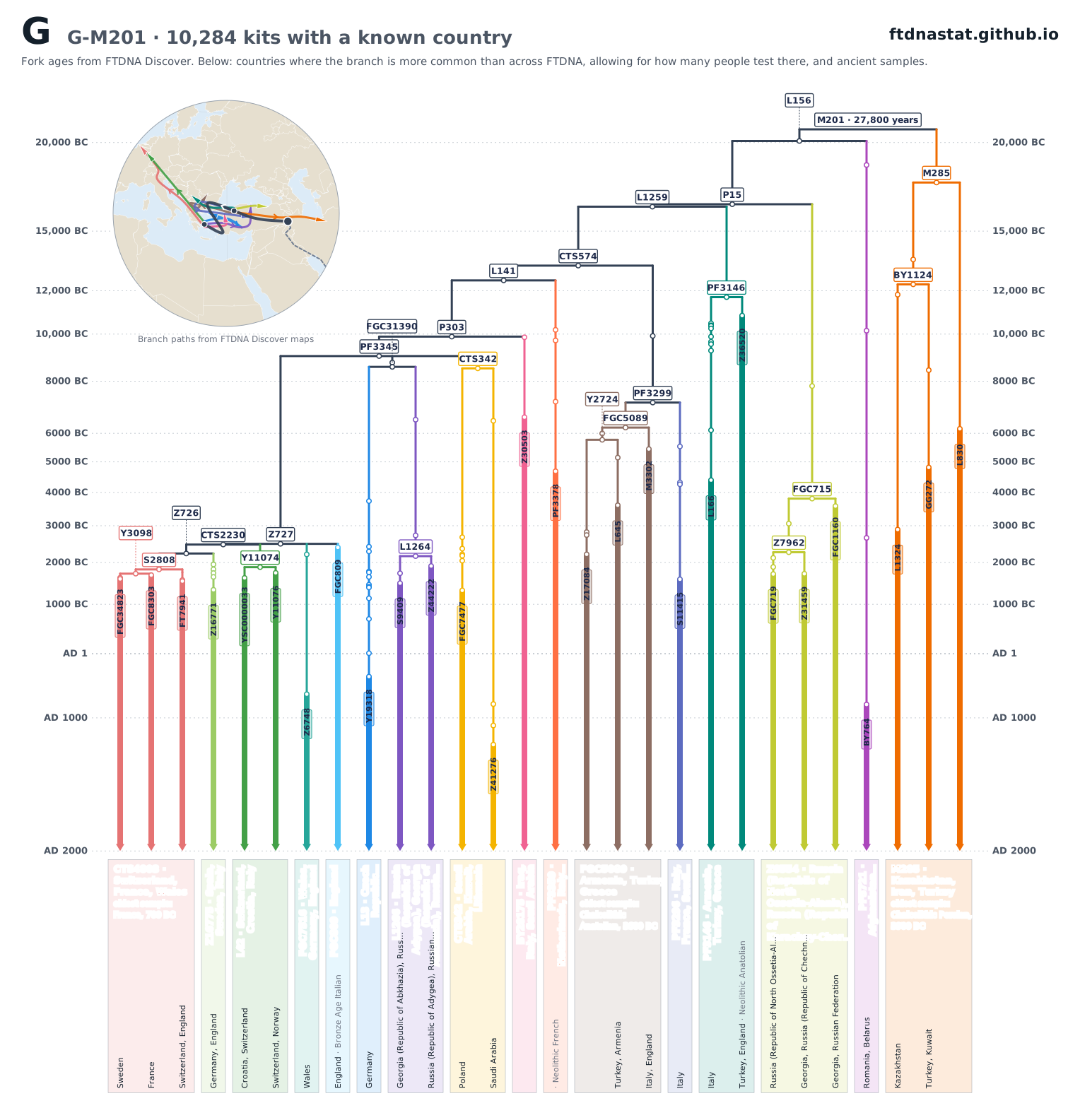
Forks by age, countries and ancient samples in one picture. Open it full size to zoom in and follow each branch to its page.
Where this branch sits on the tree from Y-Adam →
How old the branch is, by source #
Each source's estimate on one scale, in years ago. A dot is the estimate, a bar its spread (a 95% interval for YFull); no bar means the source publishes no spread. The “common ancestor” rows show when the last common ancestor of all carriers lived, the “split” rows when the branch broke off from its parent. Discover does not estimate the split, so its row shows the age of the parent branch itself.
Thickness against the parent: by ancient samples ×2.2, by living carriers ×1.1: seen then and now. All such splits on a map
How the branch grew #
How many sub-branches already existed at each moment: a sub-branch counts from the time its common ancestor lived (FamilyTreeDNA Discover estimates). Sub-branches with a known age: 3,399.
explosive growth: the number of sub-branches doubles in under 400 yearsgrowth: the number doubles in 400–1,500 yearsstagnation: no doubling within 1,500 yearsgrey: fewer than 5 sub-branches at the start of a stretch — too little to tell the rate
The branch grew fastest 6,000–1,000 years ago: its sub-branches went from 288 to 1,895.
Sub-branches of the last centuries show up only where many relatives have tested, so the right end of the curve says more about who took a test than about population growth.
New this month #
FTDNA: how much the kit count grew between the tree copies of 2026-10-09 and 2026-11-13. A kit that moved to a new sub-branch after refinement is not counted as new. YFull: samples YFull itself marks as new, in the copy of 2026-11-02; YFull drops the mark after a few weeks.
Where it grew
without a country: 60
- Saudi Arabia: +9
- Iraq: +5
- Dagestan: +4
- Turkey: +4
- Kuwait: +3
- Adygea: +3
- United Kingdom: +3
- England: +2
- Georgia: +2
- Italy: +2
- Lithuania: +2
- Palestine: +2
- Portugal: +2
- United States: +2
- Armenia: +1
- Azerbaijan: +1
- Czech Republic: +1
- France (Alsace): +1
- Germany: +1
- Netherlands: +1
- Poland: +1
- Qatar: +1
- Romania: +1
- Chuvashia: +1
- Kabardino-Balkaria: +1
- Karachay-Cherkessia: +1
- Mordovia: +1
- Tatarstan: +1
- Switzerland: +1
- Tunisia: +1
By sub-branch
New Y-DNA samples in YFull
- G-BY70232 · Italy · Arbëreshë Albanian
- G-BY91717 · Sinop · Turks
- G-FGC31400 · Vologodskaya oblast' · Russians
- G-FGC56390 · L'vivs'ka Oblast' · Ashkenazi Jews
- G-FGC65315 · Imereti · Georgians
- G-FGC659 · North Ossetia-Alania · Ossetians
- G-FT105284 · Kabardino-Balkaria · Karachay-Balkars
- G-FT421476 · England
- G-FT68976 · Al Jawf · Arabs
- G-FTB44568 · Al Qasim · Najdi Arabs
- G-FTD64962
- G-FTH73584 · Armenia
- G-Y107250
- G-Y142023 · ancient
- G-Y14601 · Lubelskie
- G-Y218394 · Nordrhein-Westfalen
- G-Y272122 · Chechnya · Chechens
- G-Y30992 · ancient
- G-Y312289 · Sivas
- G-Y345983 · Rostovskaya oblast'
- G-Y439377 · Tatarstan · Tatars
- G-Y45221 · Kuwait
- G-Y469415
- G-Y469415 · Khyber Pakhtunkhwa · Pashtuns
- G-Y601566
- G-Y619014
- G-Y643029 · not given (Antarctica flag) · Abkhazians
- G-Y648038 · Austria · Germans
- G-Y88639
- G-Z17886 · ancient
Surnames #
Surnames that testers entered at FTDNA, over the whole branch with its sub-branches: 453 distinct among 1,538 kits. FTDNA gives surnames per branch only, with no country attached, so they cannot be split by country.
- Smith 34
- Williams 28
- Chapman 23
- Bailey 20
- Canter 20
- Allen 17
- Jones 17
- Golden 16
- Merrill 16
- Howard 14
- Johnson 14
- Stacy 14
- French 13
- Cox 12
- Harper 12
Ancient samples in the branch #
922 samples from excavations belong to this branch or its subbranches. The data come from FamilyTreeDNA Discover and the Allen Ancient DNA Resource, the database of the David Reich lab. AADR gives the links to the papers, some of the places and the samples Discover lacks. “?” means Discover is unsure of the sample's place on the tree. 511 of 922 samples are marked.
There are more than 300 samples, so the chart counts them by millennium.
Where found
The oldest
- 8,126 BCE · Neolithic Anatolian, Turkey G-CTS293
- 8,100 BCE · Neolithic Mesopotamian, Iraq G-Z6552 ?
- 8,082 BCE · Neolithic Anatolian, Turkey G-PF3422
- 7,918 BCE · Neolithic Anatolian, Turkey G-L30 ?
- 7,560 BCE · Neolithic Anatolian, Turkey G-M201 ?
- 7,264 BCE · Neolithic Persian, Iran G-Z8022
- 6,900 BCE · Neolithic Anatolian, Turkey G-PF3146 ?
- 6,900 BCE · Neolithic Anatolian, Turkey G-Z6128 ?
Notable carriers #
People of the past whom FamilyTreeDNA Discover places on this branch or its sub-branches, by their remains or by their male-line descendants. Only people who lived before 1850.
- Ötzi the Iceman, ≈ 3250 BCE G-L166
- Yuya, 1390–1374 BCE G-P15
- Gamle Olof (Bure), 1390–1460 G-Z30728
- Aminoff family, 1400 G-Z37375
- Richard III of England, 1452–1485 G-L89
- Ernest Wejher, 1517–1598 G-Z2022
- Ulises Francisco Espaillat, 1823–1878 G-FTE24482
In the site's findings #
Data on this page: FamilyTreeDNA Y tree, 13 November 2026: 10,284 kits; YFull Y tree, 2 November 2026: 2,394 samples.
How to cite: ftdnastat, "Haplogroup G-M201 (G): age, countries, sub-branches", https://ftdnastat.github.io/en/clade/g-m201/, data of 2026-11-17, build 20261117-b6de9f1.
The data is licensed under CC BY 4.0: take it, rework it, just credit ftdnastat.