Haplogroup I-M253 I1
I-M253 is a branch of the FamilyTreeDNA Y tree with 29,802 kits that gave a country, counting all sub-branches. Stands out most: Sweden (45%), Norway (35%), Denmark (33%). The branch's common ancestor lived about 20k years ago: the FTDNA Discover estimate runs from 18k to 23k years ago.
Wikipedia says I1 peaks in Sweden, with 52% of males in Västra Götaland County. It gives national averages of about 38–39% in Sweden, 37% in Norway and 34.8% in Denmark. YFull (2022) dates the formation of I1 to 27,500 years ago and the common ancestor of present carriers to 4,600 years ago.
Sources: Wikipedia ↗
This branch on other trees: FTDNA Discover ↗ · TheYtree ↗
Branch SNPs: 22 · YFull nodes: 0
M253, CTS10140, CTS11036, CTS11503, CTS11751, CTS1748, CTS1965, CTS4532, CTS6006, CTS7652, CTS7751, CTS9405, FGC2441, L124, L841, Z2689, Z2699, Z2724, Z2852, Z2860, Z2885, Z2887
The same mutation arose again on other branches: CTS6006 — A-V148
Where it is found #
Countries and regions given by the branch's carriers. “Share of branch” is the part of the branch's kits that belongs to the country. “Share of country” is the part of that country's kits that falls into the branch; it is computed only for countries with at least 50 kits.
PalaeolithicMesolithicNeolithicChalcolithicBronze AgeIron AgeMiddle AgesModern eraMinus means BCE; epoch boundaries are conventional.
Where the ancestors of FamilyTreeDNA geographic project members on this branch lived, from the project maps as of 2026-10-20. Colour is the branch's share of the members at a place, or the number of its carriers; places with fewer than three are left blank. The centre and the 68% circle are corrected for some countries testing more than others. This is a picture of the sample: members chose whether to join and which place to give.
Ancient samples of the branch and its subclades with a date and a find site, from FamilyTreeDNA Discover, 629 in all. The slider picks the years; the older the era, the wider the window.
| Country / region | kits | Share of branch | Share of country |
|---|---|---|---|
| Sweden | 5,501 | 45% | |
| England | 4,282 | 15% | |
| United States | 3,538 | 11% | |
| Germany | 2,667 | 15% | |
| Finland | 2,537 | 25% | |
| Norway | 1,615 | 35% | |
| Scotland | 1,512 | 11% | |
| United Kingdom | 1,450 | 15% | |
| Ireland | 1,263 | 5.7% | |
| Denmark | 545 | 33% | |
| France | 514 | 7.9% | |
| Poland | 443 | 6.0% | |
| Netherlands | 425 | 18% | |
| Russia | 360 | 5.0% | |
| Switzerland | 319 | 11% | |
| Wales | 237 | 11% | |
| Northern Ireland | 230 | 7.7% | |
| Italy | 219 | 3.6% | |
| Spain | 176 | 4.5% | |
| Czech Republic | 154 | 6.5% | |
| Canada | 149 | 9.0% | |
| Hungary | 121 | 6.3% | |
| Ukraine | 121 | 2.7% | |
| United States (Native American)United States | 108 | 5.9% | |
| Austria | 85 | 7.8% | |
| Belgium | 84 | 12% | |
| Portugal | 75 | 3.9% | |
| Iceland | 54 | 27% | |
| Slovenia | 53 | 12% | |
| Estonia | 49 | 17% | |
| Slovakia | 49 | 5.0% | |
| Lithuania | 43 | 2.3% | |
| Romania | 42 | 3.9% | |
| Australia | 41 | 11% | |
| Bulgaria | 39 | 4.4% | |
| Bosnia and Herzegovina | 37 | 10% | |
| Mexico | 36 | 1.6% | |
| Belarus | 34 | 2.0% | |
| Puerto Rico | 34 | 5.7% | |
| Croatia | 31 | 5.7% | |
| Greece | 30 | 2.3% | |
| Brazil | 29 | 3.9% | |
| MordoviaRussia | 27 | 14% | |
| South Africa | 22 | 9.4% | |
| Albania | 21 | 7.5% | |
| England (Cornish)England | 21 | 10% | |
| Serbia | 21 | 6.0% | |
| Isle of Man | 18 | 13% | |
| Turkey | 18 | 0.7% | |
| ChuvashiaRussia | 16 | 7.3% | |
| Belgium (Flanders)Belgium | 14 | 14% | |
| Jamaica | 13 | 5.8% | |
| Latvia | 13 | 2.9% | |
| KareliaRussia | 13 | 12% | |
| Montenegro | 12 | 6.1% | |
| Belgium (Wallonia)Belgium | 10 | · | |
| Colombia | 9 | 3.0% | |
| France (Alsace)France | 9 | 12% | |
| Lebanon | 9 | 1.3% | |
| Macedonia | 9 | 5.4% | |
| New Zealand | 9 | 8.6% | |
| Azerbaijan | 8 | 1.3% | |
| Luxembourg | 8 | 6.2% | |
| TatarstanRussia | 8 | 6.8% | |
| Bahamas | 6 | 12% | |
| Cuba | 6 | 2.8% | |
| Jersey | 6 | · | |
| Palestine | 6 | 0.9% | |
| Portugal (Azores)Portugal | 6 | 10% | |
| Barbados | 5 | 6% | |
| Indonesia | 5 | 0.8% | |
| BashkortostanRussia | 5 | 4.8% | |
| DagestanRussia | 5 | 0.5% | |
| Scotland (Orkney)Scotland | 5 | · | |
| Scotland (Shetland)Scotland | 5 | · | |
| Chile | 4 | 4 of 164 | |
| Italy (Sicily)Italy | 4 | 4 of 123 | |
| Kazakhstan | 4 | 4 of 748 | |
| Moldova | 4 | 4 of 193 | |
| Sápmi (Sámi) | 4 | · | |
| Georgia | 3 | 3 of 651 | |
| Guyana | 3 | · | |
| India | 3 | 3 of 1,487 | |
| Mauritius | 3 | · | |
| Morocco | 3 | 3 of 575 | |
| Spain (Catalonia)Spain | 3 | · | |
| US Virgin Islands | 3 | · | |
| Argentina | 2 | 2 of 130 | |
| Costa Rica | 2 | 2 of 63 | |
| El Salvador | 2 | 2 of 88 | |
| Faroe Islands | 2 | · | |
| Guernsey | 2 | · | |
| Iraq | 2 | 2 of 3,221 | |
| Israel | 2 | 2 of 244 | |
| Liechtenstein | 2 | · | |
| Netherlands Antilles | 2 | · | |
| Spain (Andalusia)Spain | 2 | 2 of 79 | |
| Spain (Galicia)Spain | 2 | · | |
| Admiralty Islands | 1 | · | |
| Angola | 1 | · | |
| Armenia | 1 | 1 of 1,183 | |
| Aruba | 1 | · | |
| British Virgin Islands | 1 | · | |
| Canada (First Nations)Canada | 1 | 1 of 50 | |
| Canada (Inuit)Canada | 1 | · | |
| Egypt | 1 | 1 of 624 | |
| Guatemala | 1 | 1 of 77 | |
| Guinea | 1 | · | |
| Haiti | 1 | · | |
| Iran | 1 | 1 of 758 | |
| Orstkhoy (Aosta Valley in FTDNA) | 1 | 1 of 192 | |
| Italy (Friuli-Venezia Giulia)Italy | 1 | · | |
| Italy (Sardinia)Italy | 1 | · | |
| Japan | 1 | 1 of 529 | |
| Jordan | 1 | 1 of 362 | |
| Kosovo | 1 | 1 of 92 | |
| Kyrgyzstan | 1 | 1 of 95 | |
| Marquesas Islands | 1 | · | |
| Nicaragua | 1 | · | |
| Nigeria | 1 | 1 of 145 | |
| Norfolk Island | 1 | · | |
| Peru | 1 | 1 of 128 | |
| Qatar | 1 | 1 of 700 | |
| Kabardino-BalkariaRussia | 1 | 1 of 84 | |
| Mari ElRussia | 1 | · | |
| UdmurtiaRussia | 1 | · | |
| Saudi Arabia | 1 | 1 of 12,056 | |
| Senegal | 1 | 1 of 62 | |
| Spain (Basque)Spain | 1 | · | |
| Spain (Canary Islands)Spain | 1 | · | |
| Spain (Castile and León)Spain | 1 | · | |
| Spain (Valencia)Spain | 1 | · | |
| St. Lucia | 1 | · | |
| Suriname | 1 | · | |
| Togo | 1 | · | |
| Trinidad and Tobago | 1 | 1 of 64 | |
| Uzbekistan | 1 | 1 of 277 | |
| Venezuela | 1 | 1 of 68 |
Ancient samples and today's carriers #
How far from the branch's present-day centre its ancient samples were found. The centre and the 68% circle are the same as on the project map above. Find sites are taken from the Mitotree in FTDNA Discover.
Ancient samples with a known site: 621. 518 lie inside the 68% circle; half of all are within 630 km of the centre. Found in another part of the world and left out: 8.
Farthest from the centre
- Nizhnekhozyatovo, Chishminskiy, Bashkortostan, 1,331 CE ? I-Y7278 — 2,750 km
- Bolshie Tigany, Alexeyevsky, Tatarstan, 900 CE I-Y79293 — 2,430 km
- Cueva de la Carigüela, Piñar, Granada, Spain (Andalusia), 7,600 BCE ? I-L75 — 2,270 km
Today's carriers are geographic project members: they chose whether to join and which place to give. Ancient samples are the ones studies have covered, and some regions are better excavated than others. The chart puts samples of different eras side by side.
Migration path #
How the branch's ancestral line moved, as modelled by FamilyTreeDNA Discover: ancestor locations are estimated from present-day carriers, the path between them is the least-cost route over terrain. Dates are node TMRCAs, good to centuries. The path ends at a fork of child branches: click one and the path continues into it.
The line moved fastest 41,600–34,700 years ago: 5,300 km, about 770 km per millennium. From the root of the letter on, the line moved slowest 34,700–27,800 years ago: 240 km in 6,900 years. In all, the line covered 18,900 km along Discover's route. Joining the ancestors with straight lines gives 12,800 km; a straight line from the first point to the branch gives 4,100 km.
Show the mapHide the map The map unfolds by itself as you scroll down to it.
Loading the map…
Most common among these peoples #
From YFull samples that gave a mother tongue: the part of a people's samples that falls into this branch. The list has peoples with at least 30 samples, 3 or more of them in this branch.
- Swedes: 51% of samples (96 of 187)
- Norwegians: 45% of samples (15 of 33)
- Finns: 19% of samples (30 of 159)
- Dutch: 18% of samples (12 of 66)
- Belarusians: 13% of samples (5 of 40)
- French: 12% of samples (15 of 124)
- English: 11% of samples (115 of 1,054)
- Bosniaks: 7.4% of samples (5 of 68)
Sub-branches #
Sub-branches that have their own page (50 kits or more), as a tree: every direct one, nested ones from 1% of the branch's kits. The bar is the kits in the sub-branch with its own sub-branches; the age is when its common ancestor lived.
On the branch itself, without a resolved sub-branch: 3,544 kits.
Phylogenetic tree #
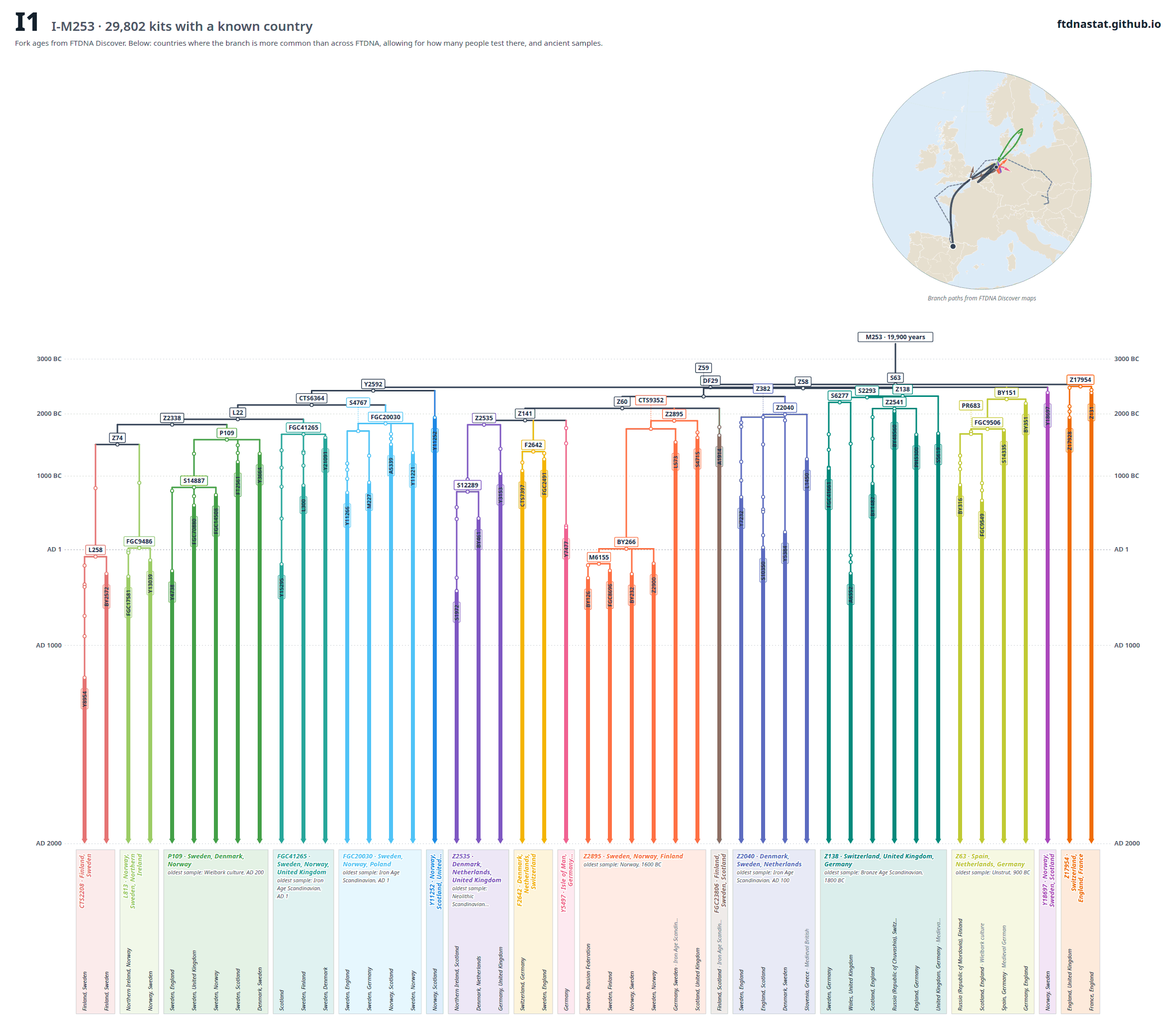
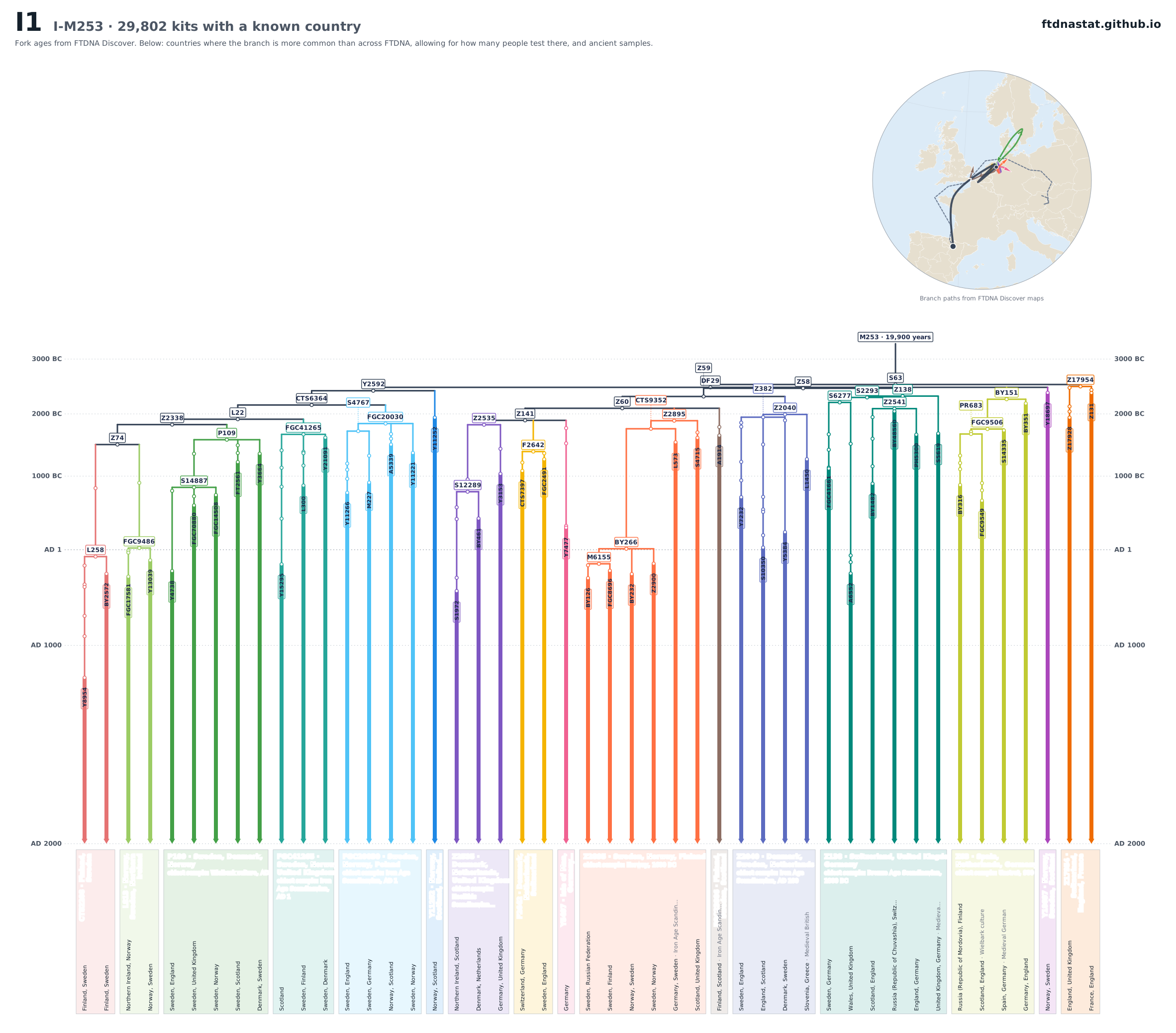
Forks by age, countries and ancient samples in one picture. Open it full size to zoom in and follow each branch to its page.
Where this branch sits on the tree from Y-Adam →
How old the branch is, by source #
Each source's estimate on one scale, in years ago. A dot is the estimate, a bar its spread (a 95% interval for YFull); no bar means the source publishes no spread. The “common ancestor” rows show when the last common ancestor of all carriers lived, the “split” rows when the branch broke off from its parent. Discover does not estimate the split, so its row shows the age of the parent branch itself.
Thickness against the parent: by ancient samples ×0.47, by living carriers ×1.0: grew later. All such splits on a map
How the branch grew #
How many sub-branches already existed at each moment: a sub-branch counts from the time its common ancestor lived (FamilyTreeDNA Discover estimates). Sub-branches with a known age: 9,771.
explosive growth: the number of sub-branches doubles in under 400 yearsgrowth: the number doubles in 400–1,500 yearsstagnation: no doubling within 1,500 yearsgrey: fewer than 5 sub-branches at the start of a stretch — too little to tell the rate
The branch grew fastest 3,000–1,000 years ago: its sub-branches went from 406 to 3,928.
Sub-branches of the last centuries show up only where many relatives have tested, so the right end of the curve says more about who took a test than about population growth.
New this month #
FTDNA: how much the kit count grew between the tree copies of 2026-10-09 and 2026-11-13. A kit that moved to a new sub-branch after refinement is not counted as new. YFull: samples YFull itself marks as new, in the copy of 2026-11-02; YFull drops the mark after a few weeks.
Where it grew
without a country: 95
- United States: +26
- Finland: +17
- Sweden: +13
- Norway: +8
- England: +5
- Germany: +5
- Poland: +5
- Scotland: +4
- Ireland: +3
- Netherlands: +3
- Chuvashia: +3
- Russia: +3
- Canada: +2
- Czech Republic: +2
- Mexico: +2
- South Africa: +2
- Belarus: +1
- Denmark: +1
- England (Cornish): +1
- France: +1
- Georgia: +1
- Italy: +1
- Northern Ireland: +1
- Palestine: +1
- Karelia: +1
- Mari El: +1
- Mordovia: +1
- Switzerland: +1
By sub-branch
- I-S63: +213
New Y-DNA samples in YFull
- I-A14806 · Bekescsaba
- I-BY169301
- I-BY76898
- I-BY77802 · Wales
- I-BY86574 · Hrodzenskaja voblasc' · Poles
- I-FGC9478
- I-FT270744 · Rheinland-Pfalz · Germans
- I-FT9307 · Calvados · French
- I-FTH96507 · Yozgat
- I-Y135258 · Ul'yanovskaya oblast'
- I-Y3000 · Kronobergs lan
- I-Y319029 · Mazowieckie
- I-Y398095
- I-Y407112 · Kirovskaya oblast' · Russians
- I-Y52052 · Dalarnas lan
- I-Y59072 · Dalarnas lan · Swedes
Surnames #
Surnames that testers entered at FTDNA, over the whole branch with its sub-branches: 1,593 distinct among 9,603 kits. FTDNA gives surnames per branch only, with no country attached, so they cannot be split by country.
- Smith 206
- Hamilton 135
- Harris 116
- Johnson 107
- Todd 99
- Gordon 94
- Lawson 90
- Wright 83
- Anderson 78
- Wilson 67
- White 65
- Jones 64
- Jackson 62
- Wood 62
- Brown 58
Ancient samples in the branch #
664 samples from excavations belong to this branch or its subbranches. The data come from FamilyTreeDNA Discover and the Allen Ancient DNA Resource, the database of the David Reich lab. AADR gives the links to the papers, some of the places and the samples Discover lacks. “?” means Discover is unsure of the sample's place on the tree. 331 of 664 samples are marked.
There are more than 300 samples, so the chart counts them by millennium.
Where found
The oldest
- 16,306 BCE · Magdalenian, France I-M253
- 11,065 BCE · Iberian Hunter-Gatherer, Spain (Catalonia) I-M253 ?
- 7,600 BCE · Mesolithic Hunter-Gatherer, Spain (Andalusia) I-L75 ?
- 6,942 BCE · Mesolithic Hunter-Gatherer, Sweden I-L840
- 3,185 BCE · Wartberg culture, Germany I-FTJ5844
- 3,163 BCE · Funnel Beaker culture, Germany I-L840
- 3,150 BCE · Wartberg culture, Germany I-FTJ5844
- 2,471 BCE · Denmark I-M253
Notable carriers #
People of the past whom FamilyTreeDNA Discover places on this branch or its sub-branches, by their remains or by their male-line descendants. Only people who lived before 1850.
- Galgedil man, ≈ 950 CE I-FTF38501
- Geoffrey de Mandeville, 1092–1144 I-BY82922
- House of Bjelbo, 1100–1396 I-S63
- Sverresborg Well Man, ≈ 1200 I-A8581
- Rothwell family, 1400 I-FGC12097
- Gulsvik family, 1412 I-FT57402
- Magnús Jónsson, 1430–1471 I-FTD21693
- Slede Dall family, 1500 I-JN65
- William Brewster, 1566–1644 I-FT1754
- Sir Ferdinando Wenman, 1576–1610 I-S63
- William Bradford, 1590–1657 I-FGC72882
- Edward Winslow, 1595–1655 I-FT334733
16 more
- George Soule, 1601–1678 I-A20032
- Kellogg family, 1626 I-FTA24986
- Emanuel Swedenborg, 1688–1772 I-Y113353
- Lee family, 1732 I-BY70495
- Matthias Calonius, 1738–1817 I-A6182
- Benjamin Rush, 1746–1813 I-BY114902
- Alexander Hamilton, 1757–1804 I-Y47396
- Ludwig van Beethoven, 1770–1827 I-FT396000
- Ichabod Crane, 1787–1857 I-L22
- Samuel Morse, 1791–1872 I-FT412956
- Ivar Aasen, 1813–1896 I-Y31088
- Leo Tolstoy, 1828–1910 I-FTC22908
- Aleksis Kivi, 1834–1872 I-FTA44407
- J. A. Folger, 1835–1889 I-FGC87227
- Mark Twain, 1835–1910 I-S63
- "Wild Bill" Hickok, 1837–1876 I-A1843
In the site's findings #
- Distinctive branch for Denmark: 33% of kits, 3.1 times the world share
Data on this page: FamilyTreeDNA Y tree, 13 November 2026: 29,802 kits.
How to cite: ftdnastat, "Haplogroup I-M253 (I1): age, countries, sub-branches", https://ftdnastat.github.io/en/clade/i-m253/, data of 2026-11-17, build 20261117-b6de9f1.
The data is licensed under CC BY 4.0: take it, rework it, just credit ftdnastat.