mtDNA haplogroup V
V is a branch of the FamilyTreeDNA mt tree with 4,308 kits that gave a country, counting all sub-branches. Stands out most: Chuvashia, Russia (10%); Finland (5.4%); Norway (5.2%). The branch's common foremother lived about 7,500 years ago: the FTDNA Discover estimate runs from 7,400 to 7,500 years ago. YFull has 1,841 samples in this branch and dates its common foremother to 2,900 years ago.
This branch on other trees: FTDNA Discover ↗ · YFull ↗
Branch mutations: 1 · 200 more at YFull
G4580A
The same mutation arose again on other branches: G4580A — M3a
YFull nodes on this branch and their SNPs that FTDNA does not have:
Where it is found #
Countries and regions given by the branch's carriers. “Share of branch” is the part of the branch's kits that belongs to the country. “Share of country” is the part of that country's kits that falls into the branch; it is computed only for countries with at least 50 kits.
PalaeolithicMesolithicNeolithicChalcolithicBronze AgeIron AgeMiddle AgesModern eraMinus means BCE; epoch boundaries are conventional.
Where the ancestors of FamilyTreeDNA geographic project members on this branch lived, from the project maps as of 2026-10-20. Colour is the branch's share of the members at a place, or the number of its carriers; places with fewer than three are left blank. The centre and the 68% circle are corrected for some countries testing more than others. This is a picture of the sample: members chose whether to join and which place to give.
Ancient samples of the branch and its subclades with a date and a find site, from FamilyTreeDNA Discover, 268 in all. The slider picks the years; the older the era, the wider the window.
| Country / region | kits | Share of branch | Share of country |
|---|---|---|---|
| United States | 494 | 2.4% | |
| Ireland | 432 | 4.2% | |
| England | 415 | 3.4% | |
| Finland | 402 | 5.4% | |
| Germany | 365 | 3.3% | |
| Sweden | 324 | 3.5% | |
| Norway | 202 | 5.2% | |
| Poland | 153 | 3.5% | |
| Scotland | 146 | 3.2% | |
| United Kingdom | 141 | 3.2% | |
| France | 121 | 2.8% | |
| Russia | 105 | 3.7% | |
| Ukraine | 100 | 4.7% | |
| Italy | 78 | 2.6% | |
| Canada | 71 | 3.3% | |
| Hungary | 55 | 5.0% | |
| Czech Republic | 53 | 4.4% | |
| United States (Native American)United States | 50 | 2.1% | |
| Spain | 48 | 3.3% | |
| Portugal | 45 | 5.0% | |
| Netherlands | 44 | 3.1% | |
| Switzerland | 44 | 3.4% | |
| Denmark | 38 | 3.4% | |
| Wales | 34 | 3.6% | |
| Northern Ireland | 33 | 5.4% | |
| Lithuania | 28 | 2.6% | |
| Austria | 27 | 3.2% | |
| Belarus | 26 | 3.5% | |
| Romania | 20 | 3.6% | |
| Slovakia | 17 | 2.8% | |
| Slovenia | 17 | 6.6% | |
| Australia | 16 | 4.2% | |
| Latvia | 11 | 4.2% | |
| Croatia | 10 | 3.4% | |
| Greece | 9 | 1.9% | |
| ChechnyaRussia | 8 | 1.7% | |
| ChuvashiaRussia | 8 | 10% | |
| Estonia | 7 | 2.9% | |
| Morocco | 7 | 4.2% | |
| Belgium | 6 | 1.5% | |
| Bulgaria | 6 | 1.6% | |
| Bahrain | 4 | 4 of 68 | |
| Belgium (Flanders)Belgium | 4 | · | |
| Bosnia and Herzegovina | 4 | 4 of 125 | |
| Brazil | 4 | 4 of 452 | |
| Mexico | 4 | 4 of 1,801 | |
| Moldova | 4 | 4 of 117 | |
| Serbia | 4 | 4 of 170 | |
| Algeria | 3 | 3 of 119 | |
| Kazakhstan | 3 | 3 of 84 | |
| Sápmi (Sámi) | 3 | · | |
| Cuba | 2 | 2 of 219 | |
| England (Cornish)England | 2 | 2 of 82 | |
| India | 2 | 2 of 374 | |
| Kosovo | 2 | · | |
| Libya | 2 | · | |
| Luxembourg | 2 | 2 of 93 | |
| Macedonia | 2 | 2 of 76 | |
| Malta | 2 | 2 of 54 | |
| Montenegro | 2 | 2 of 63 | |
| BashkortostanRussia | 2 | · | |
| Saudi Arabia | 2 | 2 of 816 | |
| Spain (Andalusia)Spain | 2 | · | |
| Spain (Cantabria)Spain | 2 | · | |
| Turkey | 2 | 2 of 903 | |
| Albania | 1 | 1 of 59 | |
| Armenia | 1 | 1 of 225 | |
| Australia (Aboriginal Australian)Australia | 1 | · | |
| Belgium (Wallonia)Belgium | 1 | · | |
| Canada (First Nations)Canada | 1 | 1 of 136 | |
| Georgia | 1 | 1 of 71 | |
| Guatemala | 1 | 1 of 50 | |
| Guernsey | 1 | · | |
| Iceland | 1 | 1 of 69 | |
| Isle of Man | 1 | · | |
| Israel | 1 | 1 of 117 | |
| Italy (Sicily)Italy | 1 | 1 of 70 | |
| Lebanon | 1 | 1 of 155 | |
| New Zealand | 1 | 1 of 104 | |
| Palestine | 1 | 1 of 70 | |
| Portugal (Azores)Portugal | 1 | · | |
| Puerto Rico | 1 | 1 of 629 | |
| DagestanRussia | 1 | 1 of 53 | |
| KareliaRussia | 1 | · | |
| Mari ElRussia | 1 | · | |
| TatarstanRussia | 1 | · | |
| Scotland (Orkney)Scotland | 1 | · | |
| Spain (Asturias)Spain | 1 | · | |
| Spain (Balearic Islands)Spain | 1 | · | |
| Spain (Canary Islands)Spain | 1 | · | |
| Spain (Madrid)Spain | 1 | · | |
| Tunisia | 1 | · |
Migration path #
How the branch's maternal line moved, as drawn on the Mitotree maps of FamilyTreeDNA Discover. Dates are node ages. The path ends at a fork of child branches: click one and the path continues into it.
Show the mapHide the map The map unfolds by itself as you scroll down to it.
Loading the map…
Most common among these peoples #
From YFull samples that gave a mother tongue: the part of a people's samples that falls into this branch. The list has peoples with at least 30 samples, 3 or more of them in this branch.
Sub-branches #
Sub-branches that have their own page (50 kits or more), as a tree: every direct one, nested ones from 1% of the branch's kits. The bar is the kits in the sub-branch with its own sub-branches; the age is when its common foremother lived.
Also 1 small sub-branch of under 5 kits: 4 kits in all. On the branch itself, without a resolved sub-branch: 1,074 kits.
Sub-branches without a page #
These sub-branches have no page of their own: each has fewer than 50 kits with a country or is a junction with an apostrophe in its name. All such branches of the FTDNA mt tree are here, even those without kits, with their mutations, age and top countries.
- V-C150T C150T 49 kits 5,800 years England 10, United States 9, Ireland 8
- V19 T16362C 42 kits 2,900 years England 10, United States 9, Ireland 8
- V22 G709A A7765G 3 kits 4,200 years Spain 2, France 1
- V24 C3573T 45 kits 3,200 years Ireland 21, Norway 5, United States 5
- V12 T7270C 40 kits 2,800 years Germany 14, England 5, United States 5
- V13 G12795A T15784C 36 kits 3,700 years Russia 6, Poland 5, Chuvashia 5
- V26 T12681C 34 kits 3,300 years Germany 10, Ireland 4, England 3
- V5 T14550C A16203G 33 kits 3,000 years Finland 32, Sweden 1
- V17 C1537T A8982G 32 kits 5,500 years United States 7, Germany 6, England 4
- V14 T8843C 31 kits 3,100 years Norway 11, Germany 6, United States 4
- V25 C14629T 29 kits 6,100 years United Kingdom 5, England 4, Germany 3
- V6 A16162G 26 kits 4,000 years Germany 8, England 4, France 2
- V23 G6734A 17 kits 5,800 years United States 6, Czech Republic 2, Hungary 2
- V4 C15250T 17 kits 4,800 years Sweden 4, Ireland 3, Germany 2
- V27 C569T 13 kits 2,900 years United States 4, Denmark 2, England 2
- V28 T10256C 4 kits Germany 3, Netherlands 1
Mitotree branches #
Mitotree is FamilyTreeDNA's new mt tree in Discover, version 2026.10.28. Branches missing from the public tree appear here, under their nearest ancestor in it. Samples, age and countries come from Discover; some branches have only a name. Next to each name are the mutations that set the branch apart from its parent, in PhyloTree notation: a lowercase letter at the end marks a transversion, “!” a back mutation, parentheses an unstable one, “d” a deletion, “.1” an insertion.
All Mitotree branches: 480 branches
- V G4580A
- V9'130'9a G207A 145 samples 6,100 years Denmark 16, United Kingdom 13, England 12
- V130 T5074C 4 samples 2,000 years Spain 1
- V61'105 T204C 141 samples 4,800 years England 19, United States 15, Ireland 7
- V61 G15930A 138 samples 2,700 years England 19, United States 15, Ireland 6
- V61b^ T195C!!! 27 samples 2,600 years England 4, Germany 3, Sweden 3
- V61b C1494T 25 samples 2,600 years England 4, Germany 3, Sweden 3
- V61b+16172 T16172C 12 samples 1,500 years England 4, Australia 1, Canada 1
- V61d C11197T 18 samples 1,600 years England 3, United States 1
- V61a T8311C 9 samples 1,000 years England 2, Ireland 1, Scotland 1
- V61c A188G 9 samples 2,700 years Croatia 2, Hungary 2
- V61c1 G9055A 5 samples 2,100 years Croatia 1
- V61c1+709 G709A 2 samples
- V61c2 G207A 4 samples 800 years Hungary 2, Croatia 1
- V61f T152C! G1888A T16311C!!! G16526A 5 samples 200 years England 3, United Kingdom 1
- V61g A3948G 3 samples 600 years United States 2, Scotland 1
- V61e C16256T 2 samples England 1
- V105 T8376C C16174T T16519C! 2 samples Norway 1
- V17'216 C1537T 116 samples 6,100 years United States 12, England 8, Germany 6
- V216 A3221G 40 samples 5,200 years United States 5, England 4, Ireland 2
- V216a T2628C C16234T 39 samples 3,400 years United States 5, England 4, Ireland 2
- V216a1 G9804A T16271C 29 samples 1,400 years United States 5, England 3, Ireland 1
- V216a2 A73G! 9 samples 1,900 years Hungary 1, Ireland 1, Romania 1
- V37 C12813T 106 samples 4,200 years Germany 12, United States 9, England 7
- V37a C16218T 100 samples 3,300 years Germany 12, United States 9, England 7
- V37a2 C16239a 49 samples 3,200 years United States 6, France 4, Germany 3
- V37a2c^ C194T 37 samples 2,000 years United States 5, Germany 3, England 2
- V37a2c^+16311 T16311C!!! 8 samples 1,000 years Germany 3, Switzerland 1
- V37a2c A1836G 3 samples 300 years United States 1
- V37a2b A10942G G15148A 3 samples 900 years Italy 1
- V37a1 C194T 48 samples 2,500 years Germany 9, England 5, United States 3
- V37a1a G3531A 5 samples 800 years Germany 3, United States 1
- V37a1b G4655A 5 samples 2,000 years Czech Republic 1, Germany 1
- V37a1c C2332T 4 samples 1,900 years England 1, Germany 1
- V37a1e T9230C 3 samples 200 years Ireland 1
- V37b A9058G 4 samples 1,500 years Poland 4
- V85"251 A15924G 98 samples 2,400 years England 12, United Kingdom 12, United States 9
- V199^ T152C! 15 samples 1,600 years United Kingdom 9, Norway 2, Northern Ireland 1
- V199 C194T 13 samples 600 years United Kingdom 9, Norway 2, Northern Ireland 1
- V199a T7568C 10 samples 200 years United Kingdom 9, Northern Ireland 1
- V251 T16519C! 10 samples 2,400 years United States 3, England 2, Norway 1
- V165 C9620a 5 samples 300 years Canada 1, England 1
- V85 A9629c 3 samples 700 years England 1
- V34 C6773T 85 samples 6,100 years Italy 8, United States 7, Portugal 4
- V34b C16234T 35 samples 6,100 years United States 4, Mexico 3, Morocco 3
- V34b2^ T16519C! 23 samples 3,100 years Mexico 3, Morocco 3, Spain 3
- V34b2 A15583G A15613G 12 samples 200 years Mexico 3, United States 2
- V34b1 T2222C 11 samples 4,100 years United Kingdom 2, United States 2, England 1
- V34b1a G11016A 9 samples 600 years United States 2, England 1, United Kingdom 1
- V34a A8440G T16189C! 24 samples 2,600 years Portugal 4, Algeria 2, Germany 2
- V34a1 C14668T 2 samples Germany 2
- V34f T4967C T14299C 12 samples 4,600 years United States 2, United States (Native American) 2, Germany 1
- V34f1^ A73G! T204C 10 samples 2,200 years United States 2, United States (Native American) 2, Germany 1
- V34f1 C707T G10203A 7 samples 600 years United States (Native American) 2, Scotland 1, United States 1
- V34c C16188T 7 samples 1,800 years Northern Ireland 3, England 1, Italy 1
- V34c1 A14790G C16234T 2 samples Italy 1
- V34+16519 T16519C! 4 samples 3,300 years Italy 3
- V34+73 A73G! T204C 3 samples 1,400 years Italy 3
- V38 T5902C 83 samples 2,600 years England 12, United States 9, Norway 5
- V38b T4679C 2 samples Germany 1
- V38c T13617C 2 samples
- V142 A5582G 78 samples 2,300 years Ireland 13, England 6, Northern Ireland 6
- V142+16519 T16519C! 12 samples 2,200 years England 3, Norway 1, United Kingdom 1
- V142a G6480A 4 samples 300 years Ireland 2
- V142+709 G709A 2 samples Northern Ireland 1
- V20"232 C16256T 77 samples 3,000 years Germany 7, United States 7, England 6
- V140 C11497T 7 samples 1,300 years Germany 3, Russia 1, Ukraine 1
- V141 T4937C 7 samples 1,100 years Denmark 3, United States 2
- V141+195 T195C!!! 6 samples 1,100 years Denmark 3, United States 2
- V232 T16304C 6 samples 1,000 years Australia 1, Ireland 1, Scotland 1
- V32 C12792T T16519C! 66 samples 6,100 years Norway 17, United States 8, England 6
- V32a G10365A G11719A! 37 samples 4,300 years Norway 17, United States 5, England 2
- V32a1 [6]2232A[7] A9007G 23 samples 1,500 years Norway 17, United States 1
- V32a1a G7269A 4 samples 800 years Norway 3, United States 1
- V32a+200 A200G 8 samples 2,000 years United States 4, United Kingdom 1
- V32e C5969T C9742T C16266T 10 samples 200 years England 3, United States 2, Canada 1
- V32b C3498T A14002G 6 samples 2,900 years Ireland 1, United States (Native American) 1
- V32b1 C16218T 3 samples 200 years Ireland 1, United States (Native American) 1
- V32c C6422T A15662G 3 samples 3,600 years
- V32d C325T T333C (C10092T) T14971C A16162t 3 samples 200 years Germany 1
- V5'124 A16203G 54 samples 4,400 years Finland 34, Lithuania 2, Sweden 1
- V124 G5821A 2 samples Lithuania 2
- V36 A15937G 48 samples 2,000 years Sweden 17, Norway 14, Finland 2
- V36a T5930C 8 samples 200 years Sweden 4, Norway 1
- V49 T14502C C15424T 44 samples 4,300 years England 4, France 4, Sweden 4
- V49b A3221G 9 samples 900 years England 1, Ireland 1, Scotland 1
- V49e G709A 5 samples 1,800 years England 2, Norway 1, Sweden 1
- V49e1 A13105G! 2 samples Sweden 1
- V49d^ A93G 4 samples 4,300 years Ireland 1
- V49d T1700C A12223G 2 samples
- V49h A9221G C12942T T16519C! 4 samples 1,200 years Portugal 1
- V49h1 T6221C 2 samples
- V49h2 [5]15944T[4] 2 samples Portugal 1
- V49+16311 T16311C!!! 3 samples 1,100 years Sweden 3
- V49f T10410a 2 samples France 2
- V49g A12990G 2 samples Slovakia 1
- V221^ G8697A 37 samples 6,000 years United States 5, England 3, Sweden 3
- V221 T3396C G16526A 35 samples 3,600 years United States 5, England 3, Sweden 3
- V221a C14155T 20 samples 2,200 years United States 4, Sweden 3, England 2
- V221a+16129 G16129A! 8 samples 400 years United States 3, United Kingdom 2
- V221a1 (T7051C) C16259T 2 samples Sweden 2
- V221b T10604C G14040A 15 samples 800 years England 1, Ireland 1, Italy 1
- V128^ C16239T 32 samples 3,900 years United States 4, England 2, Bulgaria 1
- V128 T3396C A16399G 30 samples 1,100 years United States 4, England 2, Bulgaria 1
- V128a T6956C 29 samples 1,000 years United States 4, England 2, Belgium 1
- V151^ A200G 31 samples 2,600 years Germany 6, Ukraine 4, Sweden 2
- V151 T8134C 26 samples 1,600 years Germany 6, Ukraine 4, Austria 1
- V35 G15894A 30 samples 2,600 years Poland 4, Czech Republic 2, France 2
- V35b G14305A 3 samples 200 years
- V30 C11063T 29 samples 3,500 years England 3, Germany 3, Poland 3
- V30a T9845C 3 samples 800 years Germany 1
- V30b C64T 2 samples Austria 1, Poland 1
- V215 G8485A 28 samples 6,100 years Ukraine 3, Germany 2, Ireland 2
- V215c G709A A3434G C4014T 20 samples 1,900 years Ukraine 3, Germany 2, Slovakia 2
- V215c+8485 A8485G! 15 samples 1,900 years Ukraine 3, Slovakia 2, Hungary 1
- V215c+8485+16519 T16519C! 2 samples Hungary 1
- V215a^ C16291T 4 samples 5,600 years
- V215a A484G T7759C T11944C A12747G 2 samples
- V215b A5996G G8251A T10601C A13105G! 4 samples 200 years Ireland 2, United Kingdom 1
- V60 G9380A 26 samples 2,400 years Sweden 6, Italy 3, Denmark 2
- V60+16519 T16519C! 10 samples 1,200 years Sweden 6, Denmark 1
- V60b C7758T 4 samples 600 years Ireland 1, United Kingdom 1
- V60c^ T152C! 3 samples 2,400 years Italy 3
- V60c A8050G 2 samples Italy 2
- V63 T12408C 26 samples 2,800 years Finland 2, Italy 2, Sweden 2
- V63d C16393T 3 samples 200 years Finland 2
- V63a T5788C 2 samples Italy 2
- V63b G7897A 2 samples Hungary 1
- V63c T1834C 2 samples
- V77 G6722A 26 samples 2,900 years England 5, United States 3, Canada 1
- V50 C16527T 25 samples 5,500 years Ireland 3, Italy 2, Austria 1
- V50b C11920T 13 samples 4,000 years Ireland 3, Italy 2, Austria 1
- V50b1 G15930A 7 samples 2,200 years Italy 2
- V50b1a A16162G 2 samples
- V50b2 G9287c 6 samples 1,500 years Ireland 3, Austria 1
- V50a C64T A15848G 12 samples 1,800 years England 1, Germany 1, United Kingdom 1
- V50a1 A16215G 2 samples Germany 1
- V68 C2357T A5189G G7269A 23 samples 3,100 years Germany 3, United States 3, Czech Republic 1
- V68a A1943G 13 samples 2,700 years Germany 3, Czech Republic 1, Sweden 1
- V68a1 A16399G 6 samples 1,200 years United States 1
- V68a2 C1693T T13602C 5 samples 200 years Germany 2, Sweden 1
- V68c G15930c 6 samples 200 years United Kingdom 1, United States 1
- V99 T12453C 22 samples 1,700 years England 3, United States 2, Ireland 1
- V99c C16256T 2 samples
- V54 A14370G T16519C! 21 samples 2,500 years Sweden 4, United States 3, Germany 2
- V54a G7444A 8 samples 1,200 years Sweden 4
- V54b C16111T 6 samples 300 years United States 2, Russia 1
- V100 A16180G 19 samples 2,200 years Canada 2, England 2, United States 2
- V160'161 T16172C 19 samples 2,900 years Spain 2, Estonia 1, Finland 1
- V160 T15394C 6 samples 2,600 years
- V161 T3394C 5 samples 2,200 years Estonia 1, Finland 1, Portugal 1
- V161a A9063G C16172T! 3 samples 200 years Estonia 1, Finland 1, Russia 1
- V214 A16343t (T16519C!) 18 samples 5,300 years England 4, Scotland 3, Germany 2
- V214b^ C16260T 13 samples 4,500 years Scotland 3, England 1, Germany 1
- V214b T16209C (C16519T!!) 12 samples 3,900 years Scotland 3, England 1, Germany 1
- V214b2 [2]8289CCCCCTCTA[3] 6 samples 900 years Scotland 1, United States 1
- V214b1 G10646c 2 samples England 1
- V214a A8308G 5 samples 3,900 years England 3, Germany 1, United Kingdom 1
- V214a1 C16295T 3 samples 1,500 years England 2, Germany 1
- V214a2 A8379G G11914A! 2 samples England 1, United Kingdom 1
- V171 C16344T 16 samples 3,200 years Germany 8, Denmark 2, Portugal 2
- V171a A15034t 5 samples 500 years Germany 5
- V171c G9192A T16519C! 4 samples 300 years Denmark 2, England 1
- V48 A12361G 16 samples 2,500 years Norway 12
- V108^ T152C! 15 samples 2,400 years France 2, Sweden 2, Czech Republic 1
- V108 C12370T 7 samples 1,900 years Czech Republic 1, United States 1
- V108a G7598A 6 samples 1,000 years United States 1
- V218 T15804C 15 samples 4,900 years England 3, Germany 2, France 1
- V218a T195C!!! G14569A 12 samples 2,400 years England 3, France 1, Germany 1
- V218a1 A200G T4733C 7 samples 300 years England 3, United Kingdom 1
- V218a1a C6164T 2 samples
- V218b A93G G7444A T16519C! 3 samples 200 years Germany 1
- V29 G4491A T11794C 15 samples 5,500 years Russia 3, Denmark 2, Germany 2
- V29b C5195T A13942G 12 samples 5,000 years Russia 3, Germany 2, Poland 1
- V29b2 T15449C 5 samples 4,900 years Germany 1, Russia 1, Spain 1
- V29b4 G11914A! A12615G A14002G 4 samples 600 years Russia 2
- V29b3 C9818T 3 samples 1,700 years Germany 1, Poland 1
- V29a G7269A T16311C!!! 3 samples 700 years Denmark 2
- V81 A183G 15 samples 1,700 years Italy 6, United States 2, France 1
- V81+16519 T16519C! 7 samples 1,600 years United States 2, Italy 1, Wales 1
- V81+16519+185 G185A 3 samples 900 years United States 2
- V149 G15326A 14 samples 4,200 years England 2, United States 2, Ireland 1
- V149a A15775G 8 samples 3,600 years England 1, Ireland 1, United States 1
- V149a1 T16362C G16526A 4 samples 300 years Ireland 1
- V169 A235G 14 samples 3,900 years Portugal 4, Spain 3, Cuba 1
- V169a C3960T A14793G 12 samples 2,500 years Portugal 4, Spain 2, Cuba 1
- V169a1 A9063G 6 samples 1,700 years Portugal 2
- V169a1a T12696C 5 samples 1,100 years Portugal 2
- V169a1a1 G143A 3 samples 700 years Portugal 2
- V169a2 A390G A3972G C16150T 2 samples Cuba 1
- V220 G16319A 14 samples 6,100 years Spain (Canary Islands) 4, Portugal 3, Brazil 1
- V220a T5492C A11084G C12853T T16124C 13 samples 1,500 years Spain (Canary Islands) 4, Portugal 3, Brazil 1
- V220a1 A4661G 7 samples 200 years Portugal 3, Brazil 1
- V220a2 G8584A A11734G 5 samples 200 years Spain (Canary Islands) 4, Puerto Rico 1
- V248 T195C!!! 14 samples 1,900 years United Kingdom 7, Czech Republic 1, Scotland 1
- V78 G10685A 14 samples 2,400 years Sweden 2, France 1, Germany 1
- V78a T51C 2 samples Wales 1
- V86 C10933T 14 samples 4,100 years England 4, United States 2, Germany 1
- V86a A15467G 12 samples 1,600 years England 4, United States 2, Germany 1
- V95 A14755G 14 samples 1,000 years France 5
- V138 T11318g 13 samples 4,500 years United States 2, England 1, Finland 1
- V138a A3419G 10 samples 2,300 years England 1, Finland 1, Ireland 1
- V138a1 C15853T 6 samples 900 years Finland 1
- V188 A3203G 13 samples 4,600 years Spain 3, Portugal 2, England 1
- V188a T152C! A7055G A14203G G16153A 7 samples 1,800 years Spain 3, Portugal 2
- V188a+3203 G3203A! 4 samples 1,800 years Portugal 2, Spain 1
- V188a+3203+709 G709A 3 samples 1,100 years Portugal 2
- V188a1 G15326A 2 samples Spain 2
- V57'64 T199C 13 samples 4,300 years Finland 4, England 3, Canada 1
- V57 A6527G A8673G 5 samples 800 years Finland 4, France 1
- V64 T3396C 4 samples 300 years England 2
- V57'64+150 C150T T16362C 3 samples 2,000 years Canada 1, Scotland 1
- V67 G15148A 13 samples 5,200 years Italy 3, Canada 1, France 1
- V67a G7805A 8 samples 1,300 years Canada 1, France 1
- V67+152 T152C! 4 samples 3,100 years Italy 3
- V93 C16168T 13 samples 1,800 years England 5, United Kingdom 2, United States 1
- V139^^ C151T T16519C! 12 samples 4,600 years Spain (Canary Islands) 3, Italy 2, Denmark 1
- V139^ A5001G 8 samples 3,800 years Spain (Canary Islands) 3, Portugal 1
- V139 A13836G 7 samples 2,300 years Spain (Canary Islands) 3, Portugal 1
- V139a G14258A 2 samples Spain (Canary Islands) 1
- V31 C11674T C16320T 12 samples 4,000 years Italy 2, Ireland 1, Libya 1
- V31a T292C T14634C 10 samples 1,900 years Ireland 1, Italy 1
- V31a+16261 C16261T 2 samples Italy 1
- V31b C437T 2 samples Italy 1, Libya 1
- V46 A13395G 12 samples 6,100 years Slovakia 2, Austria 1, France 1
- V46b G709A 7 samples 6,100 years France 1, Italy 1, Spain 1
- V46a T9656C 2 samples Austria 1, Slovakia 1
- V46c A6929G 2 samples Poland 1, Slovakia 1
- V90 T16325C 12 samples 4,000 years Ireland 5, Germany 2
- V90a C325T A14818c 9 samples 200 years Ireland 5
- V168 G16213A 11 samples 2,900 years Romania 1, Serbia 1, Slovenia 1
- V168a A14548G 5 samples 1,500 years Romania 1, Serbia 1
- V168a1 T16311C!!! 4 samples 200 years Romania 1, Serbia 1
- V168b A4817G 5 samples 200 years
- V83 T9126C 11 samples 5,900 years Germany 1, Norway 1, Spain 1
- V83a T8843C 5 samples 3,200 years Spain 1
- V83b T593C A5225G T7962C 3 samples 200 years Germany 1
- V87 A11404G 11 samples 6,100 years Bahrain 4, Iran 1
- V87d T74g C6122T A8745G T10237C 4 samples 200 years Bahrain 4
- V87a G9178A T10909C A14605G T16519C! 2 samples
- V87c A1811G A2399G T8639C C13902T 2 samples
- V91 A8158t 11 samples 2,000 years Portugal 4, Brazil 1, Spain 1
- V191 792.1T A6890G C14884T G15002A T16154C 10 samples 400 years United States 2
- V194 C595T 10 samples 6,100 years France 2, Czech Republic 1, England 1
- V194a A12172G A16162G T16311C!!! G16526A 8 samples 1,100 years France 2, England 1, Portugal 1
- V194a+93 A93G 3 samples 200 years England 1, France 1
- V203 A9843G (T16519C!) 10 samples 3,500 years Sweden 3, France 1
- V203a T6842C (C16519T!!) 6 samples 300 years Sweden 3
- V111 T3398C 9 samples 6,100 years Denmark 2, Hungary 1, United States 1
- V111a G3736A T8979C T16519C! 2 samples Hungary 1
- V111b A240G A4087G C6467T A7746G C16234T T16362C 2 samples Denmark 2
- V136 T11386C T16311C!!! 9 samples 1,200 years Ireland 1, Scotland 1, United States 1
- V145 A3397G 9 samples 1,200 years Sweden 3, United Kingdom 1
- V176 A1836G 9 samples 1,500 years Finland 7, Lithuania 1
- V53 G7852A T15905C 9 samples 4,300 years Italy 3
- V53a C12369T 6 samples 3,300 years Italy 3
- V53a2 C6200T 4 samples 400 years Italy 1
- V71 A73G! 9 samples 5,000 years Denmark 1, Germany 1, Hungary 1
- V71d G12406A 1 sample Belgium (Flanders) 1
- V71d1 A12642G T15482g 1 sample Belgium (Flanders) 1
- V73 T14484C 9 samples 3,200 years Ukraine 2, Germany 1, Norway 1
- V80 A1810G A13276G! 9 samples 900 years United Kingdom 3, England 2, Ireland 2
- V+709 G709A 8 samples 1,600 years Sweden 5
- V163 G12372A 8 samples 2,500 years United States 2, Italy 1
- V163a T4204C 3 samples 900 years United States 1
- V182^ T6185C 8 samples 5,200 years United Kingdom 3, Sweden 1
- V182 C11143T 5 samples 4,300 years Sweden 1
- V182a A8492G 3 samples 200 years
- V209 C8264a 8 samples 2,700 years Germany 2, United States 1
- V209a G3483A T16311C!!! 3 samples 1,900 years Germany 1
- V56 G3421A 8 samples 2,700 years Czech Republic 1, Denmark 1, England 1
- V56a T7334C T15514C 4 samples 200 years Czech Republic 1, France 1, United States 1
- V82 T4452C 8 samples 1,300 years France 3, Canada 2, Italy 1
- V125 G9921A 7 samples 4,300 years United States 1
- V125a T60C 5 samples 2,200 years
- V126 A16220c 7 samples 4,300 years Germany 3, Netherlands 1
- V126a T6758C T10256C 5 samples 600 years Germany 3, Netherlands 1
- V150 T7080C 7 samples 4,700 years Germany 3, France 1, Sweden 1
- V150a A200G A1041G T6965C 5 samples 400 years Germany 3, France 1
- V158 C9638T 7 samples 4,600 years Sweden 2
- V158a T6216C G8989A A14053G 4 samples 200 years Sweden 2
- V189 C15088T T15747C 7 samples 900 years Portugal 3, Brazil 2, Spain 2
- V33 T9592C 7 samples 2,800 years Ireland 2, Denmark 1
- V33b T152C! 3 samples 900 years Ireland 2
- V33a G8697A T10410C 2 samples
- V113^ G16274A T16311C!!! T16519C! 6 samples 2,000 years Bulgaria 1, England 1, United States 1
- V113 A9660G 5 samples 900 years England 1, United States 1
- V113a G7789A 2 samples
- V132 G14905A 6 samples 3,900 years Russia 1, United States 1
- V153 A12397G 6 samples 4,900 years Spain 2, England 1, Poland 1
- V153a T195C!!! G14162A G14569A T16075C T16189C! 3 samples 300 years Spain 2
- V153a+200 A200G 2 samples Spain 1
- V162 A4136G 6 samples 2,800 years France 2, Austria 1, Norway 1
- V175 [2]8289CCCCCTCTA[1] 6 samples 1,500 years Germany 2, France 1, Italy 1
- V223^ T16189C! 6 samples 4,200 years Sweden 1
- V223 T9701C T15511C 2 samples
- V238 T9309C 6 samples 600 years United States 2, United Kingdom 1
- V74 A11893G C12987T 6 samples 200 years Ireland 1, United Kingdom 1
- V92 G8155A 6 samples 2,800 years Spain (Canary Islands) 4, United States 1
- V118 T1766a 5 samples 2,000 years England 2, United States 1
- V154 A234G 5 samples 3,000 years Greece 1, Italy 1, Sweden 1
- V159 C3604a 5 samples 4,500 years Germany 2, Algeria 1, Scotland 1
- V172 T14180a 5 samples 2,400 years
- V178 T9495C 5 samples 2,000 years France 3, Canada 1, England 1
- V200 G13145A 5 samples 4,100 years United States 1
- V200+16129 G16129A! 4 samples 2,600 years United States 1
- V211 C463T A16051G 5 samples 500 years Czech Republic 1, France 1
- V235 A533G 5 samples 600 years Ireland 2, United Kingdom 1
- V44 C15849T 5 samples 2,300 years Portugal 3, Germany 1
- V70 T9530C 5 samples 3,400 years England 2, Denmark 1, Ireland 1
- V70a A5102G 4 samples 800 years England 2, Ireland 1
- V114 A5656G 4 samples 2,500 years England 1, Netherlands 1
- V115 G9966A 4 samples 5,300 years Denmark 1, Italy 1
- V115a A4506G A12492G 2 samples
- V147^ T16209C 4 samples 2,900 years Scotland 1, United States 1
- V147 G15927A 3 samples 1,800 years Scotland 1, United States 1
- V155 T12215C 4 samples 2,600 years Norway 4
- V164^ C4691T 4 samples 4,300 years Germany 1, Poland 1, United States 1
- V164 C5117T 3 samples 3,600 years Germany 1, Poland 1
- V167 T10321C 4 samples 3,100 years Italy 1
- V181 A2707G 4 samples 1,400 years
- V183 C7681a C16169T 4 samples 2,100 years Ireland 1, Wales 1
- V185^ A16293G 4 samples 4,200 years Germany 2, Scotland 1
- V185 C3204T A12026G 3 samples 600 years Germany 2
- V187 T480C T13015C T16519C! 4 samples 1,200 years Sweden 4
- V206 G3316A 4 samples 2,000 years Germany 1, Sweden 1
- V212 G8292A 4 samples 5,500 years Germany 1
- V212a T8610C T16126C 3 samples 1,000 years
- V229 G2056A 4 samples 3,200 years England 2
- V236 T11662C 4 samples 600 years England 1, Ireland 1, United States 1
- V42 C4735T 4 samples 6,100 years Italy 1, Portugal 1, Spain (Galicia) 1
- V42a A14388G T16311C!!! 3 samples 2,900 years Portugal 1, Spain (Galicia) 1
- V42a1 A2294G G16566A 2 samples Spain (Galicia) 1
- V62 G5231c T16519C! 4 samples 3,000 years Romania 1, Russia 1
- V62+151 C151T 3 samples 1,200 years Romania 1, Russia 1
- V89 G11914A! 4 samples 2,900 years Russia 1, Sweden 1
- V97 A13681G 4 samples 4,200 years Spain 3, Algeria 1
- V97+8251 G8251A 2 samples Spain 2
- V98 T131C 4 samples 5,900 years England 1, Portugal 1
- V112 C8275T 3 samples 3,100 years Switzerland 1
- V116 T489C G16129A! 3 samples 2,200 years Germany 1, Ireland 1, United States 1
- V116a T8426C 2 samples Ireland 1, United States 1
- V123 G5773A C16234T C16355T 3 samples 1,600 years Poland 2
- V123a T11506C 2 samples Poland 2
- V131 C16184T 3 samples 4,000 years England 1, Ireland 1
- V134 T212C T16311C!!! 3 samples 4,000 years Poland 2, Lithuania 1
- V144^ A16265c 3 samples 5,000 years United Kingdom 1
- V144 A3395G 2 samples United Kingdom 1
- V170 A4913G 3 samples 1,000 years Germany 1
- V180 A15562G 3 samples 2,000 years England 2
- V186 A10700G 3 samples 1,200 years Ireland 2
- V208 C6603T T16519C! 3 samples 1,700 years Scotland 2
- V225 C6340T 3 samples 2,000 years Denmark 1, United States 1
- V228 G9948A 3 samples 3,200 years Spain 1
- V228+16519 T16519C! 2 samples Spain 1
- V252 G1719A A6767G C14041T 3 samples 200 years England 2, United Kingdom 1
- V72 T7785C C13746T 3 samples 2,500 years England 1, United States 1
- V+16399 A16399G 2 samples United States 1
- V102 T10389C 2 samples
- V117 T15262C 2 samples Germany 1, Ukraine 1
- V119 T3338C 2 samples France 1
- V133 (T16311C!!!) T16362C 2 samples Australia 1
- V135 C15223T T16311C!!! 2 samples England 2
- V137 G6261A 2 samples Romania 1
- V146 G5147A 2 samples Ireland 2
- V174 G11440A 2 samples
- V179 A9689G 2 samples Denmark 1
- V192 (G5471A) T15204C 2 samples United Kingdom 1
- V204 G12771A 2 samples France 1
- V210 A16326G T16519C! 2 samples Germany 1
- V219 T14215C 2 samples
- V224 T10463C 2 samples Sweden 2
- V227 [2]8289CCCCCTCTA[3] 2 samples Germany 1
- V230 G12630A 2 samples England 1, Sweden 1
- V234 G9163A 2 samples Germany 2
- V239 C8855T 2 samples France 1
- V240 C5489T 2 samples
- V242 T3290C 2 samples
- V244 C16291T 2 samples
- V256 A5747G G13135A 2 samples Spain 2
- V55 C792T 2 samples Denmark 2
- V59 A2220G 2 samples Malta 2
- V245 C3106a
- V245a T14020C C16148T
- V12 T7270C
- V12c A153G 18 samples 2,700 years Germany 7, Poland 3, United States 1
- V12c1 T8506C 8 samples 1,300 years Germany 4, Poland 1
- V12c2 T12441C 4 samples 2,200 years Germany 1, United States 1
- V12f A8520G 8 samples 400 years Germany 2, United States 1, United States (Native American) 1
- V12+152 T152C! T195C!!! 7 samples 1,200 years United States (Native American) 3, England 1, United States 1
- V12+16519 T16519C! 6 samples 1,200 years Germany 2, Poland 1
- V12a C3594T! 3 samples 1,000 years Denmark 3
- V12d C12094T 2 samples
- V12e T596C T2626C (G5460A) T14470C 2 samples
- V13 G12795A T15784C
- V13a C12603T 31 samples 2,800 years Sweden 5, Norway 3, Poland 3
- V13a2 A7049G 7 samples 800 years Sweden 4
- V13a1 A3203G 6 samples 1,800 years Hungary 1, Slovenia 1
- V13a1a G12528A 3 samples 300 years
- V13b C12191T 22 samples 3,100 years Poland 6, England 1, Germany 1
- V13b1 T16311C!!! 10 samples 900 years Poland 5, England 1, Germany 1
- V13b2 T14290C 3 samples 2,200 years Poland 1
- V13c A153G 4 samples 2,800 years Bashkortostan 2
- V13c1 G13708A G14259A 3 samples 200 years Bashkortostan 2
- V13+16189 T16189C! 2 samples Ukraine 1
- V14 T8843C
- V14d A10250G 8 samples 1,500 years Norway 5, United States 1
- V14b T16311C!!! 5 samples 1,600 years Portugal 2
- V14e G14198A 3 samples 2,900 years Poland 1, Sweden 1, United States 1
- V14f T9758C 2 samples
- V17 A8982G
- V17f A16227G 17 samples 2,000 years Norway 3, United States 3, Germany 2
- V17f1 A7202G 5 samples 800 years Germany 2
- V17e C12084T G16129A! 16 samples 1,700 years England 4, United States 2, Germany 1
- V17e2 T14180C 5 samples 200 years England 1, Germany 1
- V17e1 G15773A 4 samples 200 years England 1, United States 1
- V17g G15148A 13 samples 900 years United States 2, United Kingdom 1
- V17g1 G8251A 3 samples 200 years United States 1
- V17d A16164G 10 samples 3,800 years Ireland 3
- V17d2 T13812C 5 samples 1,500 years Ireland 3
- V17d1 G5985A 3 samples 2,000 years
- V17h A16233G 9 samples 1,500 years Germany 3, Italy 2
- V17h1 T3396C 2 samples Italy 1
- V17+14180 T14180C C16291T 4 samples 200 years Spain (Canary Islands) 3, Spain 1
- V19 T16362C
- V19a C7810T 22 samples 1,800 years England 4, United States 2, Wales 2
- V19a1 T4135C 16 samples 1,000 years United States 2, Wales 2, England 1
- V19a1a T7310C 6 samples 500 years England 1, Scotland 1, United States 1
- V19b G3915A 14 samples 700 years United States 3, Ireland 1, United Kingdom 1
- V19c C14873T 5 samples 400 years England 1, Germany 1, United States 1
- V19+16261 C16261T 4 samples 2,800 years
- V19+16261+150 T150C! C16362T! 3 samples 2,300 years
- V19f T16519C! 2 samples
- V22 A7765G
- V22a^ C150T G709A 24 samples 2,400 years Spain 13, France 2
- V22a T9128C 2 samples Spain 2
- V23 G6734A
- V23a^ T16519C! 15 samples 3,400 years Czech Republic 2, Hungary 2, United States 2
- V23a C16290T 12 samples 2,000 years Czech Republic 2, United States 2, Denmark 1
- V23b A6272G T15164C 13 samples 3,000 years United States 3, Denmark 1, England 1
- V23b1 A16254G 12 samples 1,600 years United States 3, England 1, Portugal 1
- V23c A8170G A16399G 2 samples France 1
- V24 C3573T
- V24e A257G A7076G C13002T 17 samples 300 years Ireland 3, United States 2, England 1
- V24i G14249A T16126C 6 samples 200 years
- V24c A6431G 5 samples 1,400 years Norway 2, Ireland 1, Scotland 1
- V24f G13368A 4 samples 700 years Norway 3
- V24g A13269G 3 samples 300 years England 1, Ireland 1, United Kingdom 1
- V24d C9335T 2 samples Ireland 1
- V24h G9746A 2 samples
- V25 C14629T
- V25b G513A 28 samples 5,400 years England 3, Germany 3, United Kingdom 3
- V25b3 G1007A G6249A G6261A 10 samples 400 years United Kingdom 2, England 1, Scotland 1
- V25b+151 C151T T16519C! 5 samples 3,100 years England 2, Australia 1, Tunisia 1
- V25b4 C16222T 5 samples 500 years Mexico 2, Germany 1, United Kingdom 1
- V25b2 T4454C C12389T T14180C C15367T 4 samples 400 years Germany 2
- V25b2a A284G 2 samples Germany 2
- V25d A9007G 8 samples 3,500 years England 1, United Kingdom 1, United States 1
- V25h C1617T 8 samples 6,100 years Portugal 2
- V25h1 G3438A C9806T 6 samples 3,700 years Portugal 2
- V25h1a A7844G 5 samples 2,600 years Portugal 2
- V25h1a+16189 T16189C! 4 samples 2,500 years Portugal 2
- V25h2 T7389C A9377G 2 samples
- V25g T6378C 7 samples 5,000 years United States (Native American) 2, Canada 1
- V25g1 A6252G 5 samples 4,200 years United States (Native American) 2, Canada 1
- V25a G14861A 6 samples 5,900 years Denmark 1, Morocco 1, Turkey 1
- V25f G16274A 3 samples 5,000 years
- V25f1 A14007G 2 samples
- V26 T12681C
- V26a A15860G C16278T! 11 samples 2,300 years Ireland 3, Germany 1, Sweden 1
- V26a1 G3010A G6239A C13524T 4 samples 200 years Ireland 3
- V26+195 T195C!!! 5 samples 1,200 years United States 2, Germany 1
- V26b T10609C 2 samples France 1
- V27 C569T
- V27b T16519C! 9 samples 600 years United States 2, England 1, United States (Native American) 1
- V27a G12730A 5 samples 900 years Denmark 3, United States 1
- V27a1 A16335G 2 samples United States 1
- V4 C15250T
- V4c G3849A 32 samples 4,700 years Ireland 3, Germany 2, Canada 1
- V4c1 C1657T 29 samples 4,600 years Ireland 3, Canada 1, England 1
- V4c1a 291.1A 14 samples 2,600 years Ireland 3, England 1, Scotland 1
- V4c1a1 T11287C 5 samples 200 years Ireland 2
- V4c1b T16086C 12 samples 1,700 years France 1, Germany 1
- V4a T11383C 5 samples 500 years Switzerland 2, United States 1
- V6 A16162G
- V6a T294C 9 samples 2,300 years Serbia 2, Croatia 1
- V6a1 T14287C 2 samples Serbia 1
- V6e^ G709A 4 samples 3,900 years Germany 1
- V6e C459T C10484T A14339G C16256T C16320T T16362C C16465T 3 samples 200 years Germany 1
- V6f G10172A 4 samples 3,400 years Germany 1, Netherlands 1, Spain 1
- V6i A93G 4 samples 300 years
- V6c C9212T 3 samples 1,800 years Belgium 1, Hungary 1
- V6h G5417A 2 samples
Phylogenetic tree #
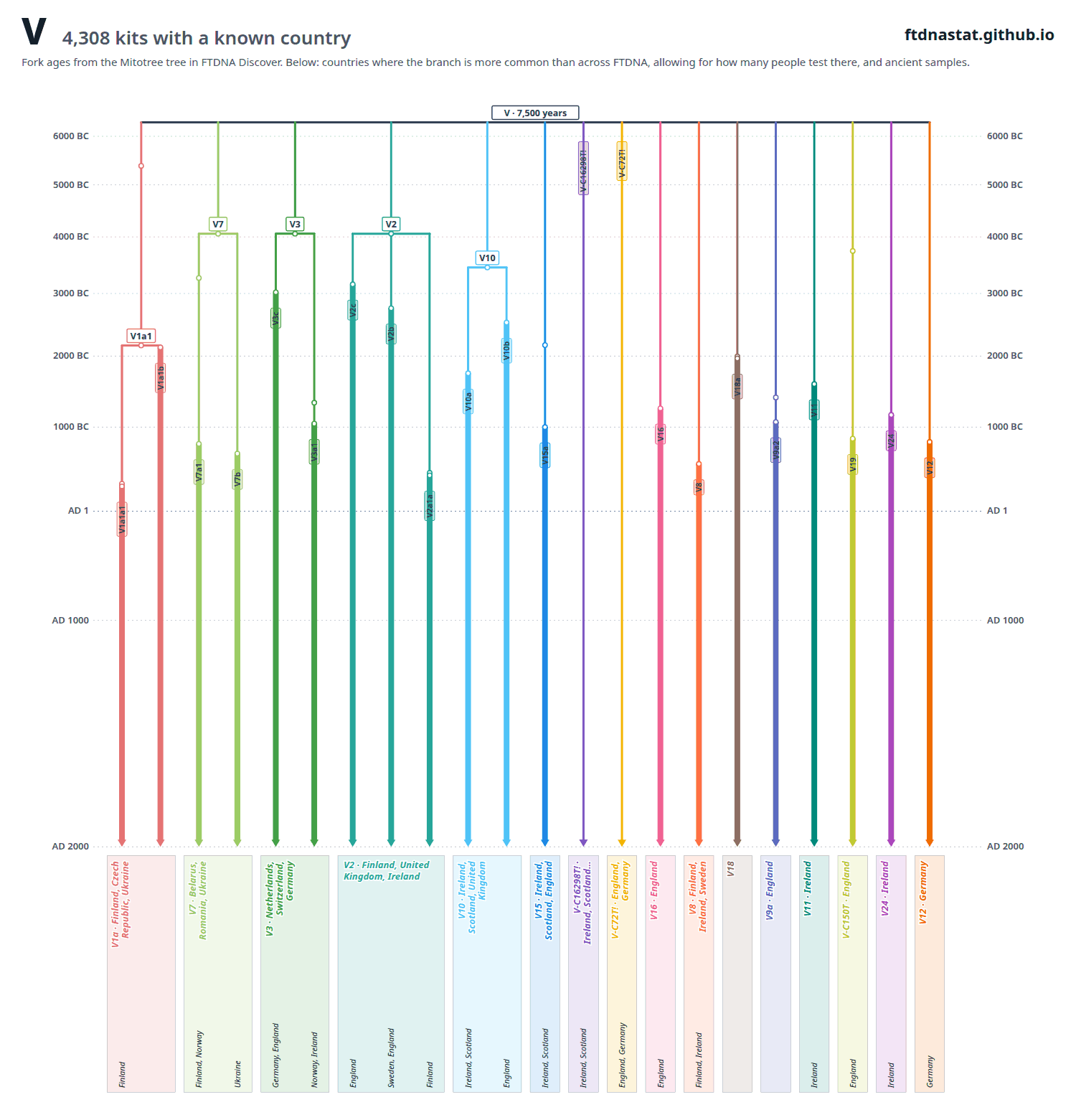
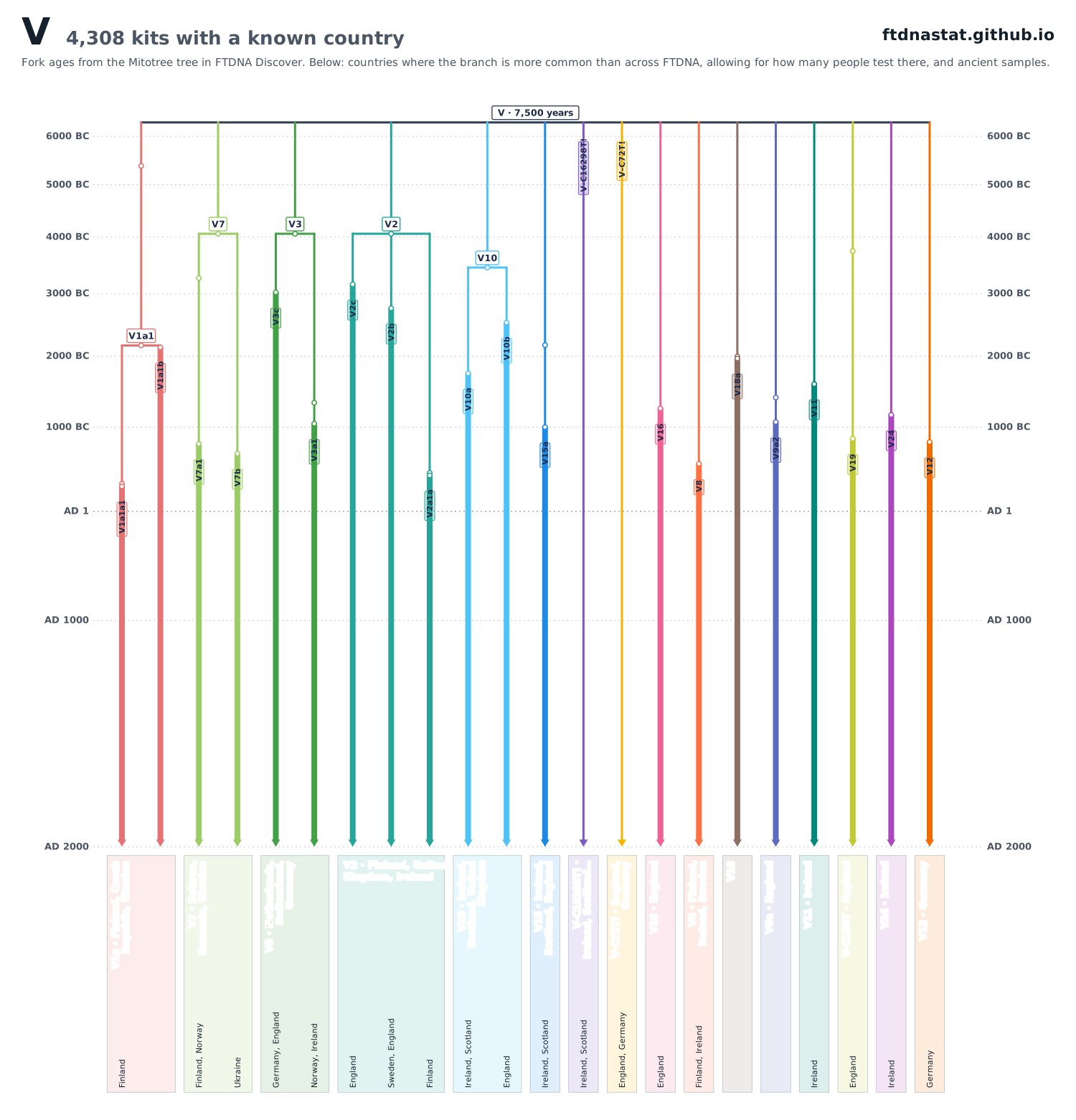
Forks by age, countries and ancient samples in one picture. Open it full size to zoom in and follow each branch to its page.
Where this branch sits on the tree from Mitochondrial Eve →
How old the branch is, by source #
Each source's estimate on one scale, in years ago. A dot is the estimate, a bar its spread (a 95% interval for YFull); no bar means the source publishes no spread. The “common foremother” rows show when the last common foremother of all carriers lived, the “split” rows when the branch broke off from its parent. Mitotree does not estimate the split, so its row shows the age of the parent branch itself.
Thickness against the parent: by ancient samples ×0.95, by living carriers ×1.0: grew later. All such splits on a map
How the branch grew #
How many sub-branches already existed at each moment: a sub-branch counts from the time its common ancestress lived (estimates of the Mitotree in FamilyTreeDNA Discover). Sub-branches with a known age: 57.
explosive growth: the number of sub-branches doubles in under 400 yearsgrowth: the number doubles in 400–1,500 yearsstagnation: no doubling within 1,500 yearsgrey: fewer than 5 sub-branches at the start of a stretch — too little to tell the rate
The branch grew fastest 6,000–5,000 years ago: its sub-branches went from 7 to 15.
Sub-branches of the last centuries show up only where many relatives have tested, so the right end of the curve says more about who took a test than about population growth.
New this month #
FTDNA: how much the kit count grew between the tree copies of 2026-10-09 and 2026-11-13. A kit that moved to a new sub-branch after refinement is not counted as new. YFull: samples YFull itself marks as new, in the copy of 2026-11-02; YFull drops the mark after a few weeks.
Where it grew
without a country: 15
- Ireland: +4
- Finland: +3
- England: +2
- Canada: +1
- Lebanon: +1
- Northern Ireland: +1
- Dagestan: +1
- Russia: +1
- Serbia: +1
- United States: +1
By sub-branch
New mtDNA samples in YFull
Ancient samples in the branch #
94 samples from excavations belong to this branch or its subbranches. Source: YFull; no culture given.
A dot is a sample, a line is the range it is dated to, the colour is its culture. A hollow dot: its placement on the tree is uncertain. The dashed line is the branch's common ancestor as FTDNA Discover estimates it.
Where found
The oldest
- 3,441 BCE · Scotland (Orkney) V
- 2,216 BCE · Italy (Trentino) V15
- 1,900 BCE · Czech Republic V6b1e
- 1,375 BCE · Czech Republic V7
- 1,340 BCE · Denmark V10b3b
- 1,320 BCE · Norway V
- 1,160 BCE · Italy (Sardinia) V
- 790 BCE · Italy V15
Data on this page: FamilyTreeDNA mtDNA tree, 11 November 2026: 4,308 kits; YFull mtDNA tree, 2 November 2026: 1,841 samples.
How to cite: ftdnastat, "mtDNA haplogroup V: age and countries", https://ftdnastat.github.io/en/mt-clade/v/, data of 2026-11-17, build 20261117-b6de9f1.
The data is licensed under CC BY 4.0: take it, rework it, just credit ftdnastat.