mtDNA haplogroup L1
L1 is a branch of the FamilyTreeDNA mt tree with 734 kits that gave a country, counting all sub-branches. Stands out most: Jamaica (21%), Brazil (8.2%), Dominican Republic (9.6%). The branch's common foremother lived about 111k years ago: the FTDNA Discover estimate runs from 102k to 120k years ago. YFull has 1,303 samples in this branch and dates its common foremother to 20k years ago.
This branch on other trees: FTDNA Discover ↗ · YFull ↗
Branch mutations: 6 · YFull nodes: 1
G3666A, A7055G, T7389C, T13789C, T14178C, G14560A
The same mutation arose again on other branches: G3666A — U5a2b3a1, F1a1c1, R9b2, H1ak, M13c, L0d1b2b2c2, L0d1c1a1a; A7055G — U8a, D4j1b, M71b; T7389C — L7b, B4f, B4a1a1w, L3d3b, L0d1a1a; T13789C — U2d2; T14178C — U4b2a1a, H1j7, Y, M77; G14560A — B4a1a1a5, F2h, H1v1b, HV7, X2a2, X3, N21, N1a3a3, L3c, L0d1b2a, and 2 more
YFull nodes on this branch and their SNPs that FTDNA does not have:
Where it is found #
Countries and regions given by the branch's carriers. “Share of branch” is the part of the branch's kits that belongs to the country. “Share of country” is the part of that country's kits that falls into the branch; it is computed only for countries with at least 50 kits.
PalaeolithicMesolithicNeolithicChalcolithicBronze AgeIron AgeMiddle AgesModern eraMinus means BCE; epoch boundaries are conventional.
Where the ancestors of FamilyTreeDNA geographic project members on this branch lived, from the project maps as of 2026-10-20. Colour is the branch's share of the members at a place, or the number of its carriers; places with fewer than three are left blank. The centre and the 68% circle are corrected for some countries testing more than others. This is a picture of the sample: members chose whether to join and which place to give.
Ancient samples of the branch and its subclades with a date and a find site, from FamilyTreeDNA Discover, 28 in all. The slider picks the years; the older the era, the wider the window.
Migration path #
How the branch's maternal line moved, as drawn on the Mitotree maps of FamilyTreeDNA Discover. Dates are node ages. The path ends at a fork of child branches: click one and the path continues into it.
Show the mapHide the map The map unfolds by itself as you scroll down to it.
Loading the map…
Most common among these peoples #
From YFull samples that gave a mother tongue: the part of a people's samples that falls into this branch. The list has peoples with at least 30 samples, 3 or more of them in this branch.
Sub-branches #
Sub-branches that have their own page (50 kits or more), as a tree: every direct one, nested ones from 1% of the branch's kits. The bar is the kits in the sub-branch with its own sub-branches; the age is when its common foremother lived.
On the branch itself, without a resolved sub-branch: 1 kit.
Phylogenetic tree #
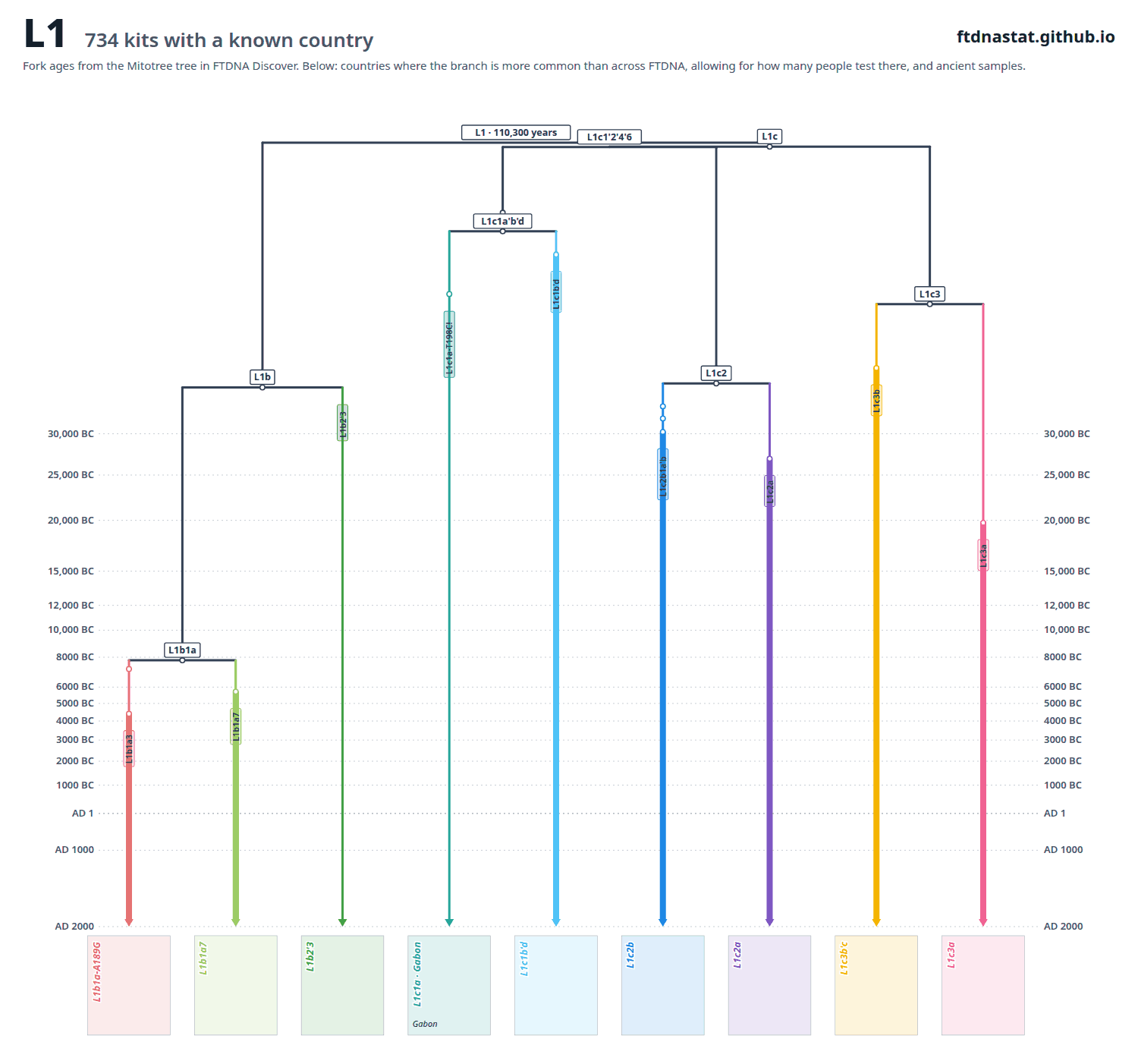
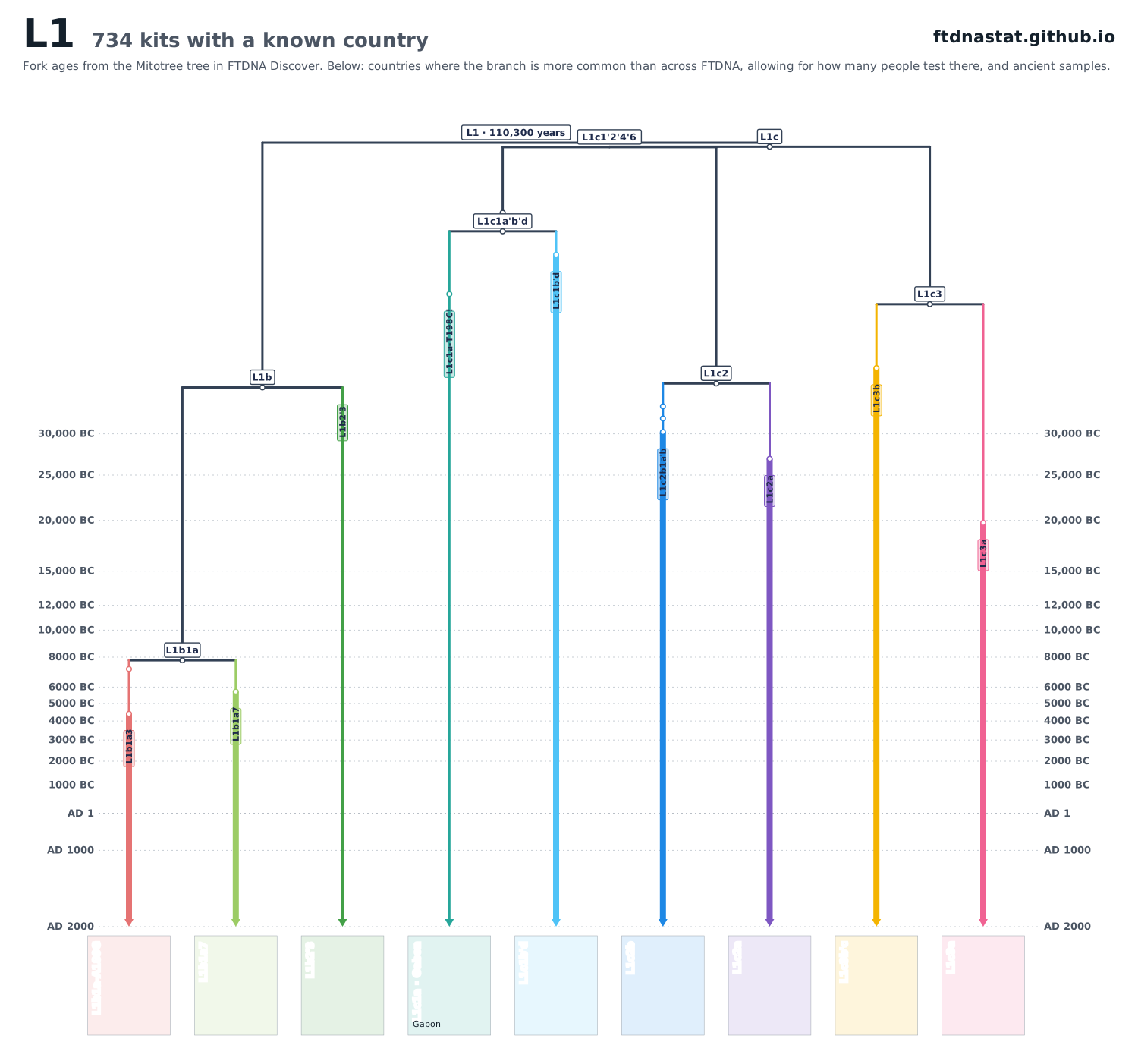
Forks by age, countries and ancient samples in one picture. Open it full size to zoom in and follow each branch to its page.
Where this branch sits on the tree from Mitochondrial Eve →
How old the branch is, by source #
Each source's estimate on one scale, in years ago. A dot is the estimate, a bar its spread (a 95% interval for YFull); no bar means the source publishes no spread. The “common foremother” rows show when the last common foremother of all carriers lived, the “split” rows when the branch broke off from its parent. Mitotree does not estimate the split, so its row shows the age of the parent branch itself.
Thickness against the parent: by ancient samples ×0.24, by living carriers ×0.73: rare. All such splits on a map
How the branch grew #
How many sub-branches already existed at each moment: a sub-branch counts from the time its common ancestress lived (estimates of the Mitotree in FamilyTreeDNA Discover). Sub-branches with a known age: 94.
explosive growth: the number of sub-branches doubles in under 400 yearsgrowth: the number doubles in 400–1,500 yearsstagnation: no doubling within 1,500 yearsgrey: fewer than 5 sub-branches at the start of a stretch — too little to tell the rate
The branch grew fastest 11k–1,000 years ago: its sub-branches went from 42 to 93.
Sub-branches of the last centuries show up only where many relatives have tested, so the right end of the curve says more about who took a test than about population growth.
New this month #
FTDNA: how much the kit count grew between the tree copies of 2026-10-09 and 2026-11-13. A kit that moved to a new sub-branch after refinement is not counted as new. YFull: samples YFull itself marks as new, in the copy of 2026-11-02; YFull drops the mark after a few weeks.
Where it grew
without a country: 6
- United States: +3
- Brazil: +1
- Somalia: +1
By sub-branch
New mtDNA samples in YFull
- L1b1a16b2 · Stavropol'skiy kray
- L1b1a6a
Ancient samples in the branch #
2 samples from excavations belong to this branch or its subbranches. Source: YFull; no culture given.
Data on this page: FamilyTreeDNA mtDNA tree, 11 November 2026: 734 kits; YFull mtDNA tree, 2 November 2026: 1,303 samples.
How to cite: ftdnastat, "mtDNA haplogroup L1: age and countries", https://ftdnastat.github.io/en/mt-clade/l1/, data of 2026-11-17, build 20261117-b6de9f1.
The data is licensed under CC BY 4.0: take it, rework it, just credit ftdnastat.